


Page 75 - Read Online
P. 75
Page 10 of 28           Choi et al. Energy Mater. 2025, 5, 500106  https://dx.doi.org/10.20517/energymater.2025.50

               Table 1. TE performance of i-TE hydrogels with cellulose networks
                Authors        Polymers   Ion conductors    Type   S  [mV/K]   σ  [mS/cm]    κ  [W/mK]
                                                                   i
                                                                                              i
                                                                                i
                Li et al. [30]  Cellulose  NaOH             p      24          20            0.48
                      [35]
                Qian et al.    CMC        LiCl              p      2.96        36.51         0.575
                               PAM
                      [37]
                Chen et al.    CBC        LiTFSI            p      11.5        0.71          -
                     [40]
                Han et al.     PQ-10      NaOH              p      24.2        0.3           -
                Yang et al. [47]  CMC     NaCl              p      17.1        26.8          -
                               PAA
                Hu et al. [74]  Cellulose  BzMe NOH         p      2.61        38            0.18
                                              3
                       [76]
                Cheng et al.   Cellulose  KCl               P      22.1        0.64          0.31
                Wu et al. [43]  BC        NaCl              n      -27.2       204.2         -
                      [50]                     2-
                Chen et al.    Cellulose   [CuCl ]          n      -26.3       8.47          0.47
                                              4
                               PVA
                     [75]
                Liu et al.     Cellulose   [BMIM][BF ]      n      -20.1       13.9          0.46
                                                 4
                               PAM
                      [77]
                Chen et al.    BC         NaOH              n      -20.7       0.62          -
                               PVA
               S : Ionic Seebeck coefficient; σ : ionic conductivity; κ : thermal conductivity; PQ-10: quaternized hydroxyethyl cellulose; CBC: carboxylated bacterial
                i                 i            i
               cellulose; PAM: polyacrylamide; CMC: sodium carboxymethyl cellulose; BC: bacterial cellulose; PAA: polyacrylic acid; PVA: polyvinyl alcohol.


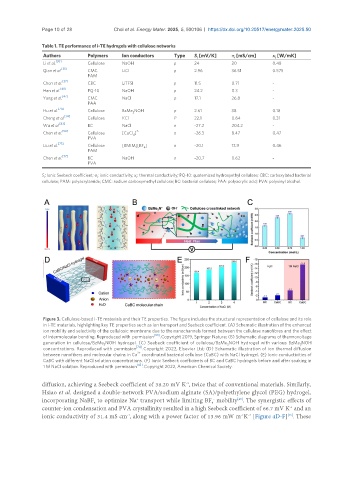
                Figure 3. Cellulose-based i-TE materials and their TE properties. The figure includes the structural representation of cellulose and its role
                in i-TE materials, highlighting key TE properties such as ion transport and Seebeck coefficient. (A) Schematic illustration of the enhanced
                ion mobility and selectivity of the cellulosic membrane due to the nanochannels formed between the cellulose nanofibres and the effect
                                                     [30]
                of intermolecular bonding. Reproduced with permission  . Copyright 2019, Springer Nature; (B) Schematic diagrams of thermovoltage
                generation in cellulose/BzMe NOH hydrogel. (C) Seebeck coefficient of cellulose/BzMe NOH hydrogel with various BzMe NOH
                                    3                                         3                       3
                                               [74]
                concentrations. Reproduced with  permission  . Copyright 2022, Elsevier Ltd; (D) Schematic illustration of ion thermal diffusion
                                               2+
                between nanofibers and molecular chains in Ca  coordinated bacterial cellulose (CaBC) with NaCl hydrogel. (E) Ionic conductivities of
                CaBC with different NaCl solution concentrations. (F) Ionic Seebeck coefficients of BC and CaBC hydrogels before and after soaking in
                1 M NaCl solution. Reproduced with permission [43] . Copyright 2022, American Chemical Society.
               diffusion, achieving a Seebeck coefficient of 38.20 mV K , twice that of conventional materials. Similarly,
                                                                -1
               Hsiao et al. designed a double-network PVA/sodium alginate (SA)/polyethylene glycol (PEG) hydrogel,
               incorporating NaBF  to optimize Na  transport while limiting BF  mobility . The synergistic effects of
                                                                         -
                                               +
                                                                                 [45]
                                 4
                                                                        4
               counter-ion condensation and PVA crystallinity resulted in a high Seebeck coefficient of 66.7 mV K  and an
                                                                                                   -1
               ionic conductivity of 31.4 mS cm , along with a power factor of 13.96 mW m K  [Figure 4D-F] . These
                                                                                                  [45]
                                            -1
                                                                                  -1
                                                                                     -2

