


Page 72 - Read Online
P. 72
Choi et al. Energy Mater. 2025, 5, 500106  https://dx.doi.org/10.20517/energymater.2025.50  Page 7 of 28

               be attributed to the difference in Eastman entropy inherent in their TE processes [61,62] . In i-TE materials,
               Eastman entropy is influenced by interactions between ions and their surrounding environments, such as
                                         [52]
               matrix, solvent and other ions . Consequently, the S  of hydrogel-based i-TE systems is highly dependent
                                                             T
               on the ionic species, hydrogel network structure, and hydration state. In addition, if the thermal mobility
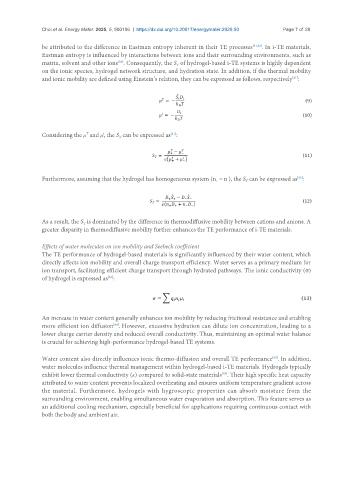
               and ionic mobility are defined using Einstein’s relation, they can be expressed as follows, respectively :
                                                                                                    [21]


                                    i
                                                           [21]
                              T
               Considering the μ  and μ, the S  can be expressed as :
                                         T


                                                                                                     [56]
               Furthermore, assuming that the hydrogel has homogeneous system (n  = n ), the S  can be expressed as :
                                                                                    T
                                                                          +
                                                                              -


               As a result, the S  is dominated by the difference in thermodiffusive mobility between cations and anions. A
                             T
               greater disparity in thermodiffusive mobility further enhances the TE performance of i-TE materials.

               Effects of water molecules on ion mobility and Seebeck coefficient
               The TE performance of hydrogel-based materials is significantly influenced by their water content, which
               directly affects ion mobility and overall charge transport efficiency. Water serves as a primary medium for
               ion transport, facilitating efficient charge transport through hydrated pathways. The ionic conductivity (σ)
               of hydrogel is expressed as :
                                     [63]


               An increase in water content generally enhances ion mobility by reducing frictional resistance and enabling
               more efficient ion diffusion . However, excessive hydration can dilute ion concentration, leading to a
                                       [64]
               lower charge carrier density and reduced overall conductivity. Thus, maintaining an optimal water balance
               is crucial for achieving high-performance hydrogel-based TE systems.


               Water content also directly influences ionic thermo-diffusion and overall TE performance . In addition,
                                                                                             [65]
               water molecules influence thermal management within hydrogel-based i-TE materials. Hydrogels typically
               exhibit lower thermal conductivity (κ) compared to solid-state materials . Their high specific heat capacity
                                                                            [63]
               attributed to water content prevents localized overheating and ensures uniform temperature gradient across
               the material. Furthermore, hydrogels with hygroscopic properties can absorb moisture from the
               surrounding environment, enabling simultaneous water evaporation and absorption. This feature serves as
               an additional cooling mechanism, especially beneficial for applications requiring continuous contact with
               both the body and ambient air.

