


Page 69 - Read Online
P. 69
Page 4 of 28            Choi et al. Energy Mater. 2025, 5, 500106  https://dx.doi.org/10.20517/energymater.2025.50


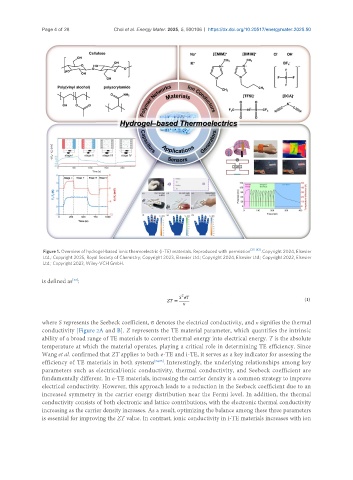
                Figure 1. Overview of hydrogel-based ionic thermoelectric (i-TE) materials. Reproduced with permission [35-40] . Copyright 2024, Elsevier
                Ltd.; Copyright 2025, Royal Society of Chemistry; Copyright 2023, Elsevier Ltd.; Copyright 2024, Elsevier Ltd.; Copyright 2022, Elsevier
                Ltd.; Copyright 2023, Wiley-VCH GmbH.

               is defined as :
                         [53]


               where S represents the Seebeck coefficient, σ denotes the electrical conductivity, and κ signifies the thermal
               conductivity [Figure 2A and B]. Z represents the TE material parameter, which quantifies the intrinsic
               ability of a broad range of TE materials to convert thermal energy into electrical energy. T is the absolute
               temperature at which the material operates, playing a critical role in determining TE efficiency. Since
               Wang et al. confirmed that ZT applies to both e-TE and i-TE, it serves as a key indicator for assessing the
               efficiency of TE materials in both systems [54,55] . Interestingly, the underlying relationships among key
               parameters such as electrical/ionic conductivity, thermal conductivity, and Seebeck coefficient are
               fundamentally different. In e-TE materials, increasing the carrier density is a common strategy to improve
               electrical conductivity. However, this approach leads to a reduction in the Seebeck coefficient due to an
               increased symmetry in the carrier energy distribution near the Fermi level. In addition, the thermal
               conductivity consists of both electronic and lattice contributions, with the electronic thermal conductivity
               increasing as the carrier density increases. As a result, optimizing the balance among these three parameters
               is essential for improving the ZT value. In contrast, ionic conductivity in i-TE materials increases with ion

