


Page 71 - Read Online
P. 71
Page 6 of 28            Choi et al. Energy Mater. 2025, 5, 500106  https://dx.doi.org/10.20517/energymater.2025.50

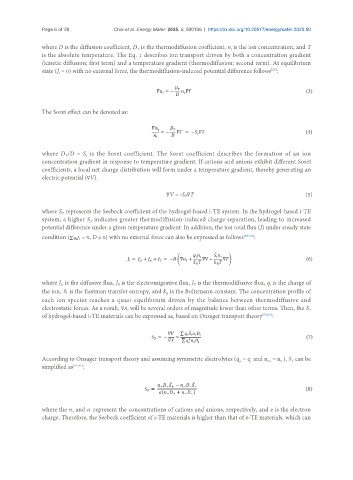
               where D is the diffusion coefficient, D  is the thermodiffusion coefficient, n is the ion concentration, and T
                                               T
                                                                               i
               is the absolute temperature. The Eq. 1 describes ion transport driven by both a concentration gradient
               (kinetic diffusion; first term) and a temperature gradient (thermodiffusion; second term). At equilibrium
               state (J = 0) with no external force, the thermodiffusion-induced potential difference follows :
                                                                                            [56]
                     i


               The Soret effect can be denoted as:


               where D /D = S  is the Soret coefficient. The Soret coefficient describes the formation of an ion
                       T
                              t
               concentration gradient in response to temperature gradient. If cations and anions exhibit different Soret
               coefficients, a local net charge distribution will form under a temperature gradient, thereby generating an
               electric potential (∇V).

                                                         ∇V = -S ∇T                                                                            (5)
                                                               T

               where S  represents the Seebeck coefficient of the hydrogel-based i-TE system. In the hydrogel-based i-TE
                      T
               system, a higher S  indicates greater thermodiffusion-induced charge separation, leading to increased
                               T
               potential difference under a given temperature gradient. In addition, the ion total flux (J) under steady state
               condition (   = 0, D ≠ 0) with no external force can also be expressed as follows [58-60] :


               where J  is the diffusive flux, J  is the electromigrative flux, J  is the thermodiffusive flux, q is the charge of
                                         E
                                                                                            i
                      D
                                                                  T
               the ion,   is the Eastman transfer entropy, and k  is the Boltzmann constant. The concentration profile of
                                                         B
               each ion species reaches a quasi-equilibrium driven by the balance between thermodiffusive and
               electrostatic forces. As a result, ∇n will be several orders of magnitude lower than other terms. Then, the S
                                                                                                         T
                                            i
               of hydrogel-based i-TE materials can be expressed as, based on Onsager transport theory [59,60] :


               According to Onsager transport theory and assuming symmetric electrolytes (q  = q  and n  = n ), S  can be
                                                                                      -
                                                                                           0+
                                                                                  +
                                                                                                   T
                                                                                                0-
               simplified as [21,61] :


               where the n  and n  represent the concentrations of cations and anions, respectively, and e is the electron
                         +
                               -
               charge. Therefore, the Seebeck coefficient of i-TE materials is higher than that of e-TE materials, which can

