


Page 87 - Read Online
P. 87
Page 22 of 28           Choi et al. Energy Mater. 2025, 5, 500106  https://dx.doi.org/10.20517/energymater.2025.50


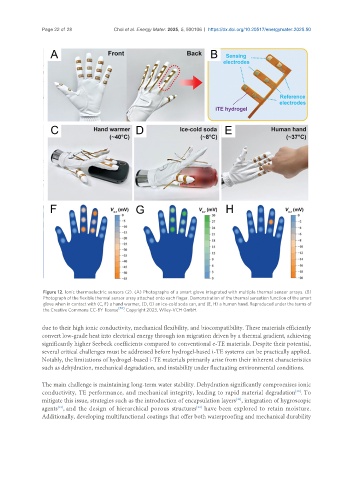
                Figure 12. Ionic thermoelectric sensors (2). (A) Photographs of a smart glove integrated with multiple thermal sensor arrays. (B)
                Photograph of the flexible thermal sensor array attached onto each finger. Demonstration of the thermal sensation function of the smart
                glove when in contact with (C, F) a hand warmer, (D, G) an ice-cold soda can, and (E, H) a human hand. Reproduced under the terms of
                the Creative Commons CC-BY license [40] . Copyright 2023, Wiley-VCH GmbH.

               due to their high ionic conductivity, mechanical flexibility, and biocompatibility. These materials efficiently
               convert low-grade heat into electrical energy through ion migration driven by a thermal gradient, achieving
               significantly higher Seebeck coefficients compared to conventional e-TE materials. Despite their potential,
               several critical challenges must be addressed before hydrogel-based i-TE systems can be practically applied.
               Notably, the limitations of hydrogel-based i-TE materials primarily arise from their inherent characteristics
               such as dehydration, mechanical degradation, and instability under fluctuating environmental conditions.


               The main challenge is maintaining long-term water stability. Dehydration significantly compromises ionic
               conductivity, TE performance, and mechanical integrity, leading to rapid material degradation . To
                                                                                                     [35]
                                                                                 [40]
               mitigate this issue, strategies such as the introduction of encapsulation layers , integration of hygroscopic
               agents , and the design of hierarchical porous structures  have been explored to retain moisture.
                                                                   [92]
                    [91]
               Additionally, developing multifunctional coatings that offer both waterproofing and mechanical durability

