


Page 89 - Read Online
P. 89
Page 24 of 28           Choi et al. Energy Mater. 2025, 5, 500106  https://dx.doi.org/10.20517/energymater.2025.50


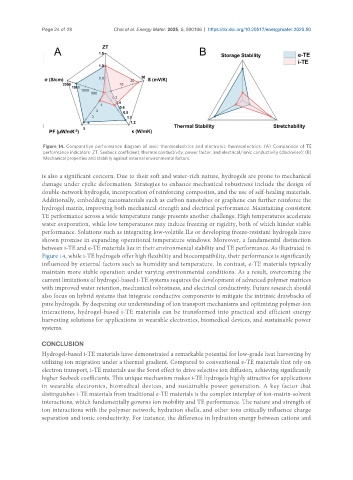
                Figure 14. Comparative performance diagram of ionic thermoelectrics and electronic thermoelectrics. (A) Comparison of TE
                performance indicators: ZT, Seebeck coefficient, thermal conductivity, power factor, and electrical/ionic conductivity (clockwise); (B)
                Mechanical properties and stability against external environmental factors.

               is also a significant concern. Due to their soft and water-rich nature, hydrogels are prone to mechanical
               damage under cyclic deformation. Strategies to enhance mechanical robustness include the design of
               double-network hydrogels, incorporation of reinforcing composites, and the use of self-healing materials.
               Additionally, embedding nanomaterials such as carbon nanotubes or graphene can further reinforce the
               hydrogel matrix, improving both mechanical strength and electrical performance. Maintaining consistent
               TE performance across a wide temperature range presents another challenge. High temperatures accelerate
               water evaporation, while low temperatures may induce freezing or rigidity, both of which hinder stable
               performance. Solutions such as integrating low-volatile ILs or developing freeze-resistant hydrogels have
               shown promise in expanding operational temperature windows. Moreover, a fundamental distinction
               between i-TE and e-TE materials lies in their environmental stability and TE performance. As illustrated in
               Figure 14, while i-TE hydrogels offer high flexibility and biocompatibility, their performance is significantly
               influenced by external factors such as humidity and temperature. In contrast, e-TE materials typically
               maintain more stable operation under varying environmental conditions. As a result, overcoming the
               current limitations of hydrogel-based i-TE systems requires the development of advanced polymer matrices
               with improved water retention, mechanical robustness, and electrical conductivity. Future research should
               also focus on hybrid systems that integrate conductive components to mitigate the intrinsic drawbacks of
               pure hydrogels. By deepening our understanding of ion transport mechanisms and optimizing polymer-ion
               interactions, hydrogel-based i-TE materials can be transformed into practical and efficient energy
               harvesting solutions for applications in wearable electronics, biomedical devices, and sustainable power
               systems.


               CONCLUSION
               Hydrogel-based i-TE materials have demonstrated a remarkable potential for low-grade heat harvesting by
               utilizing ion migration under a thermal gradient. Compared to conventional e-TE materials that rely on
               electron transport, i-TE materials use the Soret effect to drive selective ion diffusion, achieving significantly
               higher Seebeck coefficients. This unique mechanism makes i-TE hydrogels highly attractive for applications
               in wearable electronics, biomedical devices, and sustainable power generation. A key factor that
               distinguishes i-TE materials from traditional e-TE materials is the complex interplay of ion-matrix-solvent
               interactions, which fundamentally governs ion mobility and TE performance. The nature and strength of
               ion interactions with the polymer network, hydration shells, and other ions critically influence charge
               separation and ionic conductivity. For instance, the difference in hydration energy between cations and

