


Page 57 - Read Online
P. 57
Lekbir et al. Energy Mater. 2025, 5, 500101  https://dx.doi.org/10.20517/energymater.2025.46  Page 9 of 17


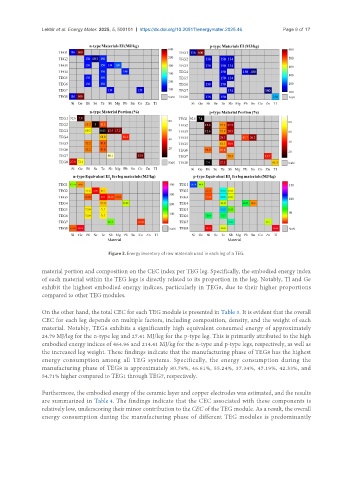
                                      Figure 3. Energy inventory of raw materials used in each leg of a TEG.

               material portion and composition on the CEC index per TEG leg. Specifically, the embodied energy index
               of each material within the TEG legs is directly related to its proportion in the leg. Notably, Tl and Ge
               exhibit the highest embodied energy indices, particularly in TEG8, due to their higher proportions
               compared to other TEG modules.


               On the other hand, the total CEC for each TEG module is presented in Table 3. It is evident that the overall
               CEC for each leg depends on multiple factors, including composition, density, and the weight of each
               material. Notably, TEG8 exhibits a significantly high equivalent consumed energy of approximately
               24.79 MJ/leg for the n-type leg and 27.41 MJ/leg for the p-type leg. This is primarily attributed to the high
               embodied energy indices of 464.96 and 214.41 MJ/kg for the n-type and p-type legs, respectively, as well as
               the increased leg weight. These findings indicate that the manufacturing phase of TEG8 has the highest
               energy  consumption  among  all  TEG  systems.  Specifically,  the  energy  consumption  during  the
               manufacturing phase of TEG8 is approximately 80.78%, 46.61%, 55.24%, 37.34%, 47.19%, 42.33%, and
               54.71% higher compared to TEG1 through TEG7, respectively.


               Furthermore, the embodied energy of the ceramic layer and copper electrodes was estimated, and the results
               are summarized in Table 4. The findings indicate that the CEC associated with these components is
               relatively low, underscoring their minor contribution to the CEC of the TEG module. As a result, the overall
               energy consumption during the manufacturing phase of different TEG modules is predominantly

