


Page 54 - Read Online
P. 54
Page 6 of 17           Lekbir et al. Energy Mater. 2025, 5, 500101  https://dx.doi.org/10.20517/energymater.2025.46


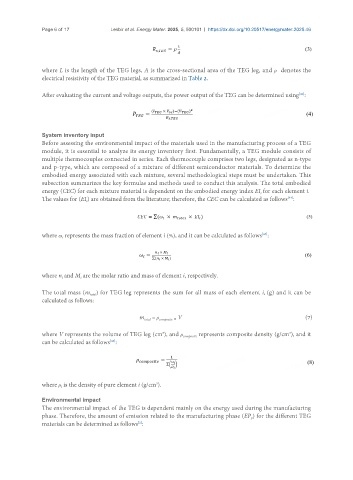
               where L is the length of the TEG legs, A is the cross-sectional area of the TEG leg, and ρ  denotes the
               electrical resistivity of the TEG material, as summarized in Table 2.

                                                                                                      [42]
               After evaluating the current and voltage outputs, the power output of the TEG can be determined using :


               System inventory input
               Before assessing the environmental impact of the materials used in the manufacturing process of a TEG
               module, it is essential to analyze its energy inventory first. Fundamentally, a TEG module consists of
               multiple thermocouples connected in series. Each thermocouple comprises two legs, designated as n-type
               and p-type, which are composed of a mixture of different semiconductor materials. To determine the
               embodied energy associated with each mixture, several methodological steps must be undertaken. This
               subsection summarizes the key formulas and methods used to conduct this analysis. The total embodied
               energy (CEC) for each mixture material is dependent on the embodied energy index EI for each element i.
                                                                                         i
               The values for (EI) are obtained from the literature; therefore, the CEC can be calculated as follows :
                                                                                                  [44]
                              i


               where ω represents the mass fraction of element i (%), and it can be calculated as follows :
                                                                                         [45]
                      i


               where n and M are the molar ratio and mass of element i, respectively.
                            i
                      i
               The total mass (m ) for TEG leg represents the sum for all mass of each element i, (g) and it can be
                               total
               calculated as follows:

                                                              V                                                                                    (7)
                                                m  = ρ composite ×
                                                  total
                                                        3
                                                                                                   3
               where V represents the volume of TEG leg (cm ), and ρ composite  represents composite density (g/cm ), and it
               can be calculated as follows :
                                      [46]


               where ρ is the density of pure element i (g/cm ).
                                                      3
                      i
               Environmental impact
               The environmental impact of the TEG is dependent mainly on the energy used during the manufacturing
               phase. Therefore, the amount of emission related to the manufacturing phase (EP ) for the different TEG
                                                                                      p
                                                [2]
               materials can be determined as follows :

