


Page 60 - Read Online
P. 60
Page 12 of 17          Lekbir et al. Energy Mater. 2025, 5, 500101  https://dx.doi.org/10.20517/energymater.2025.46

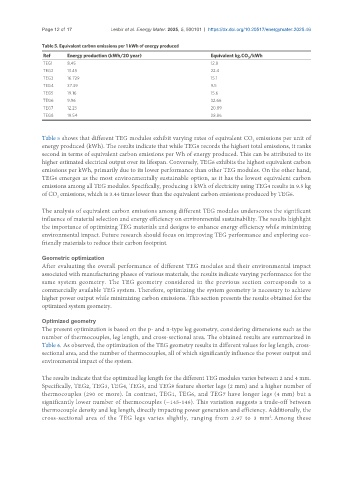
               Table 5. Equivalent carbon emissions per 1 kWh of energy produced
                Ref     Energy production (kWh/20 year)                 Equivalent kg.CO /kWh
                                                                                     2
                TEG1    8.45                                            12.8
                TEG2    13.45                                           22.4
                TEG3    16.729                                          15.1
                TEG4    37.39                                           9.5
                TEG5    19.16                                           15.6
                TEG6    9.96                                            32.66
                TEG7    12.23                                           20.89
                TEG8    19.54                                           28.86


               Table 5 shows that different TEG modules exhibit varying rates of equivalent CO  emissions per unit of
                                                                                      2
               energy produced (kWh). The results indicate that while TEG8 records the highest total emissions, it ranks
               second in terms of equivalent carbon emissions per Wh of energy produced. This can be attributed to its
               higher estimated electrical output over its lifespan. Conversely, TEG6 exhibits the highest equivalent carbon
               emissions per kWh, primarily due to its lower performance than other TEG modules. On the other hand,
               TEG4 emerges as the most environmentally sustainable option, as it has the lowest equivalent carbon
               emissions among all TEG modules. Specifically, producing 1 kWh of electricity using TEG4 results in 9.5 kg
               of CO  emissions, which is 3.44 times lower than the equivalent carbon emissions produced by TEG6.
                    2

               The analysis of equivalent carbon emissions among different TEG modules underscores the significant
               influence of material selection and energy efficiency on environmental sustainability. The results highlight
               the importance of optimizing TEG materials and designs to enhance energy efficiency while minimizing
               environmental impact. Future research should focus on improving TEG performance and exploring eco-
               friendly materials to reduce their carbon footprint.


               Geometric optimization
               After evaluating the overall performance of different TEG modules and their environmental impact
               associated with manufacturing phases of various materials, the results indicate varying performance for the
               same system geometry. The TEG geometry considered in the previous section corresponds to a
               commercially available TEG system. Therefore, optimizing the system geometry is necessary to achieve
               higher power output while minimizing carbon emissions. This section presents the results obtained for the
               optimized system geometry.

               Optimized geometry
               The present optimization is based on the p- and n-type leg geometry, considering dimensions such as the
               number of thermocouples, leg length, and cross-sectional area. The obtained results are summarized in
               Table 6. As observed, the optimization of the TEG geometry results in different values for leg length, cross-
               sectional area, and the number of thermocouples, all of which significantly influence the power output and
               environmental impact of the system.


               The results indicate that the optimized leg length for the different TEG modules varies between 2 and 4 mm.
               Specifically, TEG2, TEG3, TEG4, TEG5, and TEG8 feature shorter legs (2 mm) and a higher number of
               thermocouples (290 or more). In contrast, TEG1, TEG6, and TEG7 have longer legs (4 mm) but a
               significantly lower number of thermocouples (~145-146). This variation suggests a trade-off between
               thermocouple density and leg length, directly impacting power generation and efficiency. Additionally, the
                                                                                            2
               cross-sectional  area  of  the  TEG  legs  varies  slightly,  ranging  from  2.97  to  3  mm . Among  these

