


Page 62 - Read Online
P. 62
Page 14 of 17          Lekbir et al. Energy Mater. 2025, 5, 500101  https://dx.doi.org/10.20517/energymater.2025.46

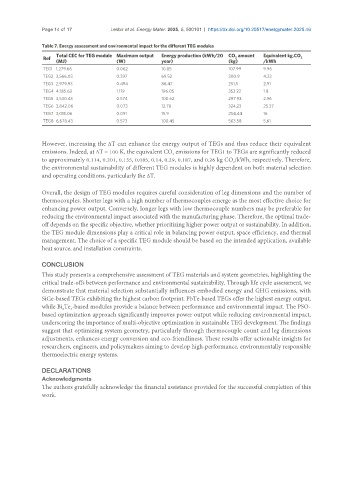
               Table 7. Energy assessment and environmental impact for the different TEG modules
                    Total CEC for TEG module  Maximum output   Energy production (kWh/20  CO  amount   Equivalent kg.CO
                Ref                                                             2                     2
                    (MJ)                (W)            year)                  (kg)        /kWh
                TEG1 1,279.66           0.062          10.85                  107.99      9.96
                TEG2 3,566.03           0.397          69.52                  300.9       4.33
                TEG3 2,979.93           0.494          86.47                  251.5       2.91
                TEG4 4,185.63           1.119          196.05                 353.22      1.8
                TEG5 3,530.43           0.574          100.62                 297.93      2.96
                TEG6 3,842.06           0.073          12.78                  324.23      25.37
                TEG7 3,015.06           0.091          15.9                   254.44      16
                TEG8 6,678.43           0.573          100.45                 563.58      5.61


               However, increasing the ΔT can enhance the energy output of TEGs and thus reduce their equivalent
               emissions. Indeed, at ΔT = 100 K, the equivalent CO  emissions for TEG1 to TEG8 are significantly reduced
                                                           2
               to approximately 0.114, 0.201, 0.135, 0.085, 0.14, 0.29, 0.187, and 0.26 kg CO /kWh, respectively. Therefore,
                                                                                2
               the environmental sustainability of different TEG modules is highly dependent on both material selection
               and operating conditions, particularly the ΔT.


               Overall, the design of TEG modules requires careful consideration of leg dimensions and the number of
               thermocouples. Shorter legs with a high number of thermocouples emerge as the most effective choice for
               enhancing power output. Conversely, longer legs with low thermocouple numbers may be preferable for
               reducing the environmental impact associated with the manufacturing phase. Therefore, the optimal trade-
               off depends on the specific objective, whether prioritizing higher power output or sustainability. In addition,
               the TEG module dimensions play a critical role in balancing power output, space efficiency, and thermal
               management. The choice of a specific TEG module should be based on the intended application, available
               heat source, and installation constraints.

               CONCLUSION
               This study presents a comprehensive assessment of TEG materials and system geometries, highlighting the
               critical trade-offs between performance and environmental sustainability. Through life cycle assessment, we
               demonstrate that material selection substantially influences embodied energy and GHG emissions, with
               SiGe-based TEGs exhibiting the highest carbon footprint. PbTe-based TEGs offer the highest energy output,
               while Bi Te -based modules provide a balance between performance and environmental impact. The PSO-
                         3
                      2
               based optimization approach significantly improves power output while reducing environmental impact,
               underscoring the importance of multi-objective optimization in sustainable TEG development. The findings
               suggest that optimizing system geometry, particularly through thermocouple count and leg dimensions
               adjustments, enhances energy conversion and eco-friendliness. These results offer actionable insights for
               researchers, engineers, and policymakers aiming to develop high-performance, environmentally responsible
               thermoelectric energy systems.


               DECLARATIONS
               Acknowledgments
               The authors gratefully acknowledge the financial assistance provided for the successful completion of this
               work.

