


Page 102 - Read Online
P. 102
Kumar et al. Energy Mater. 2025, 5, 500109  https://dx.doi.org/10.20517/energymater.2025.22  Page 9 of 17


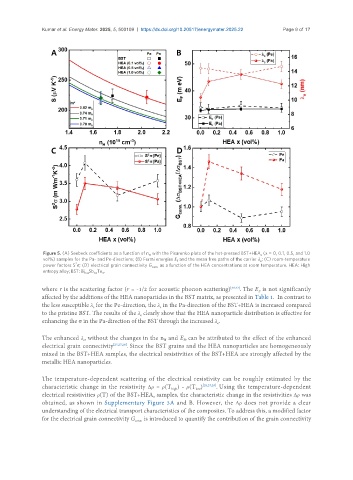
                Figure 5. (A) Seebeck coefficients as a function of n  with the Pisarenko plots of the hot-pressed BST+HEA  (x = 0, 0.1, 0.5, and 1.0
                                                   H
                                                                                         x
                vol%) samples for the Pa- and Pe-directions; (B) Fermi energies E  and the mean free paths of the carrier λ ; (C) room-temperature
                                                                                         e
                                                             F
                          2
                power factors S σ; (D) electrical grain connectivity G conn.  as a function of the HEA concentrations at room temperature. HEA: High
                entropy alloy; BST: Bi Sb Te .
                              0.4
                                 1.6
                                   3
               where r is the scattering factor (r = -1/2 for acoustic phonon scattering) [39,42] . The E  is not significantly
                                                                                        F
               affected by the additions of the HEA nanoparticles in the BST matrix, as presented in Table 1.  In contrast to
               the less susceptible λ  for the Pe-direction, the λ  in the Pa-direction of the BST+HEA is increased compared
                                e
                                                       e
               to the pristine BST. The results of the λ  clearly show that the HEA nanoparticle distribution is effective for
                                                e
               enhancing the σ in the Pa-direction of the BST through the increased λ .
                                                                          e
               The enhanced λ , without the changes in the n  and E , can be attributed to the effect of the enhanced
                                                        H
                             e
                                                               F
               electrical grain connectivity [25,27,28] . Since the BST grains and the HEA nanoparticles are homogeneously
               mixed in the BST+HEA samples, the electrical resistivities of the BST+HEA are strongly affected by the
               metallic HEA nanoparticles.
               The temperature-dependent scattering of the electrical resistivity can be roughly estimated by the
               characteristic change in the resistivity  Δρ =  ρ(T ) -  ρ(T ) [25,27,28] . Using the temperature-dependent
                                                           high
                                                                   low
               electrical resistivities ρ(T) of the BST+HEA  samples, the characteristic change in the resistivities Δρ was
                                                     x
               obtained, as shown in Supplementary Figure 3A and B. However, the  Δρ does not provide a clear
               understanding of the electrical transport characteristics of the composites. To address this, a modified factor
               for the electrical grain connectivity G  is introduced to quantify the contribution of the grain connectivity
                                               conn.

