


Page 105 - Read Online
P. 105
Page 12 of 17          Kumar et al. Energy Mater. 2025, 5, 500109  https://dx.doi.org/10.20517/energymater.2025.22

               By subtracting the κ  from κ , the temperature-dependent lattice and bipolar thermal conductivities
                                        total
                                 e
               κ +κ (T)  of  the  hot-pressed  BST+HEA   samples  for  the  Pa-  and  Pe-directions  are  obtained,  as
                L
                   b
                                                   x
               shown Figure 6C. The κ +κ (T) shows the conventional 1/T behavior near room temperature and the bipolar
                                   L
                                      b
               effect above 350 K. The 1/T behavior of the thermal conductivity is primarily caused by the Umklapp
               processes of acoustic phonon . The thermal conductivity of narrow bandgap materials increases with
                                         [39]
               temperature due to the bipolar effect, which is associated with thermally excited minority carriers at high
               temperatures. The bipolar effect is associated with the narrow bandgap (~0.1 eV) of bismuth tellurides at
               high temperatures . Therefore, the κ  dominates near room temperature in the κ +κ (T) of the BST+HEA x
                               [40]
                                               L
                                                                                       b
                                                                                     L
               samples.
               Figure 6D  shows  the  lattice  thermal  conductivities  κ   of  the  BST+HEA   samples  for  the  Pa-  and
                                                                                 x
                                                                L
               Pe-directions at 300 K. While the Pe-direction κ  are slightly reduced, the κ  of the Pa-direction are clearly
                                                                               L
                                                        L
               decreased by the HEA nanoparticles below 0.5 vol% but noticeably increase at 1.0 vol%. The increased
               Pa-direction κ  in the BST+HEA composites is attributed to enhanced grain connectivity, consistent with
                           L
               the results for λ . Interestingly, the Pa-direction κ  of pure BST is lower than that of the Pe-direction due to
                                                         L
                            e
               the preferred orientation of the BST layers. However, in the BST+HEA composite with 1.0 vol% HEA, the
               Pa-direction κ  becomes higher than the Pe-direction κ . This unconventional increase in Pa-direction κ L
                           L
                                                               L
               supports the idea that HEA nanoparticles enhance grain connectivity along the Pa-direction in the BST
               matrix.
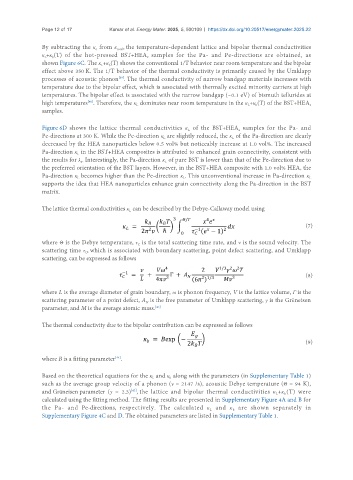
               The lattice thermal conductivities κ  can be described by the Debye-Callaway model using
                                             L
                                                                                                        (7)
               where Θ is the Debye temperature, τ  is the total scattering time rate, and ν is the sound velocity. The
                                               C
               scattering time τ , which is associated with boundary scattering, point defect scattering, and Umklapp
                              C
               scattering, can be expressed as follows
                                                                                                        (8)


               where L is the average diameter of grain boundary, ω is phonon frequency, V is the lattice volume, Γ is the
               scattering parameter of a point defect, A  is the free parameter of Umklapp scattering, γ is the Grüneisen
                                                  N
               parameter, and M is the average atomic mass. [43]


               The thermal conductivity due to the bipolar contribution can be expressed as follows

                                                                                                        (9)


               where B is a fitting parameter .
                                        [44]
               Based on the theoretical equations for the κ  and κ  along with the parameters (in Supplementary Table 1)
                                                    L
                                                          b
               such as the average group velocity of a phonon (ν = 2147 /s), acoustic Debye temperature (Θ = 94 K),
               and Grüneisen parameter  (γ  =  2.3) , the  lattice  and  bipolar  thermal  conductivities  κ +κ (T)  were
                                             [43]
                                                                                              L
                                                                                                 b
               calculated using the fitting method. The fitting results are presented in Supplementary Figure 4A and B for
               the  Pa-  and  Pe-directions,  respectively.  The  calculated  κ   and  κ   are  shown  separately  in
                                                                        L
                                                                               b
               Supplementary Figure 4C and D. The obtained parameters are listed in Supplementary Table 1.

