


Page 107 - Read Online
P. 107
Page 14 of 17          Kumar et al. Energy Mater. 2025, 5, 500109  https://dx.doi.org/10.20517/energymater.2025.22


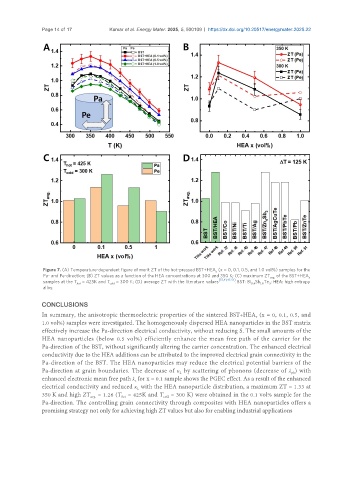
                Figure 7. (A) Temperature-dependent figure of merit ZT of the hot-pressed BST+HEA  (x = 0, 0.1, 0.5, and 1.0 vol%) samples for the
                                                                          x
                Pa- and Pe-direction; (B) ZT values as a function of the HEA concentrations at 300 and 350 K; (C) maximum ZT avg.  of the BST+HEA   x
                samples at the T  = 425K and T cold  = 300 K; (D) average ZT with the literature  values [37,41,45-51] . BST: Bi Sb Te ; HEA: high entropy
                                                                                      0.4
                           hot
                                                                                            3
                                                                                         1.6
                alloy.
               CONCLUSIONS
               In summary, the anisotropic thermoelectric properties of the sintered BST+HEA  (x = 0, 0.1, 0.5, and
                                                                                       x
               1.0 vol%) samples were investigated. The homogeneously dispersed HEA nanoparticles in the BST matrix
               effectively increase the Pa-direction electrical conductivity, without reducing S. The small amounts of the
               HEA nanoparticles (below 0.5 vol%) efficiently enhance the mean free path of the carrier for the
               Pa-direction of the BST, without significantly altering the carrier concentration. The enhanced electrical
               conductivity due to the HEA additions can be attributed to the improved electrical grain connectivity in the
               Pa-direction of the BST. The HEA nanoparticles may reduce the electrical potential barriers of the
               Pa-direction at grain boundaries. The decrease of  κ  by scattering of phonons (decrease of  λ ) with
                                                              L
                                                                                                   ph
               enhanced electronic mean free path λ  for x = 0.1 sample shows the PGEC effect. As a result of the enhanced
                                              e
               electrical conductivity and reduced κ  with the HEA nanoparticle distribution, a maximum ZT = 1.33 at
                                               L
               350 K and high ZT  = 1.26 (T  = 425K and T  = 300 K) were obtained in the 0.1 vol% sample for the
                                avg.
                                          hot
                                                        cold
               Pa-direction. The controlling grain connectivity through composites with HEA nanoparticles offers a
               promising strategy not only for achieving high ZT values but also for enabling industrial applications

