


Page 100 - Read Online
P. 100
Kumar et al. Energy Mater. 2025, 5, 500109  https://dx.doi.org/10.20517/energymater.2025.22  Page 7 of 17


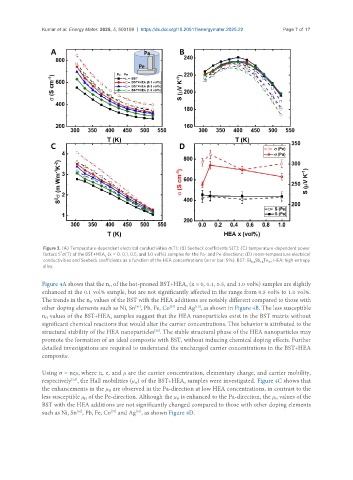
                Figure 3. (A) Temperature-dependent electrical conductivities σ(T); (B) Seebeck coefficients S(T); (C) temperature-dependent power
                     2
                factors S σ(T) of the BST+HEA  (x = 0, 0.1, 0.5, and 1.0 vol%) samples for the Pa- and Pe-directions; (D) room-temperature electrical
                                    x
                conductivities and Seebeck coefficients as a function of the HEA concentrations (error bar: 5%). BST: Bi Sb Te .; HEA: high entropy
                                                                                            3
                                                                                         1.6
                                                                                      0.4
                alloy.
               Figure 4A shows that the n  of the hot-pressed BST+HEA  (x = 0, 0.1, 0.5, and 1.0 vol%) samples are slightly
                                      H
                                                                x
               enhanced at the 0.1 vol% sample, but are not significantly affected in the range from 0.5 vol% to 1.0 vol%.
               The trends in the n  values of the BST with the HEA additions are notably different compared to those with
                               H
                                                          [37]
                                               [41]
               other doping elements such as Ni, Sn , Pb, Fe, Co  and Ag , as shown in Figure 4B. The less susceptible
                                                                   [10]
               n  values of the BST+HEA  samples suggest that the HEA nanoparticles exist in the BST matrix without
                H
                                      x
               significant chemical reactions that would alter the carrier concentrations. This behavior is attributed to the
               structural stability of the HEA nanoparticles . The stable structural phase of the HEA nanoparticles may
                                                     [20]
               promote the formation of an ideal composite with BST, without inducing chemical doping effects. Further
               detailed investigations are required to understand the unchanged carrier concentrations in the BST+HEA
               composite.
               Using σ = neμ, where n, e, and μ are the carrier concentration, elementary charge, and carrier mobility,
               respectively , the Hall mobilities (μ ) of the BST+HEA  samples were investigated. Figure 4C shows that
                         [2,5]
                                              H
                                                               x
               the enhancements in the μ  are observed in the Pa-direction at low HEA concentrations, in contrast to the
                                      H
               less susceptible μ  of the Pe-direction. Although the μ  is enhanced to the Pa-direction, the μ  values of the
                                                                                              H
                             H
                                                             H
               BST with the HEA additions are not significantly changed compared to those with other doping elements
                                               [10]
                                      [37]
               such as Ni, Sn , Pb, Fe, Co  and Ag , as shown Figure 4D.
                           [41]

