


Page 99 - Read Online
P. 99
Page 6 of 17           Kumar et al. Energy Mater. 2025, 5, 500109  https://dx.doi.org/10.20517/energymater.2025.22


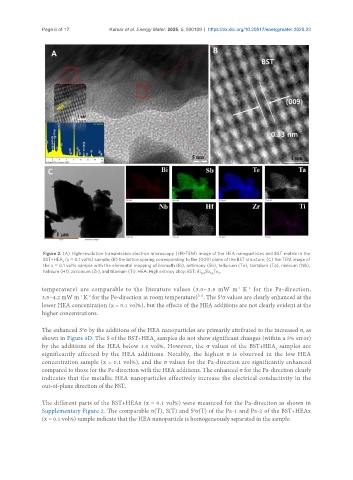
                Figure 2. (A) High-resolution transmission electron microscopy (HR-TEM) image of the HEA nanoparticles and BST matrix in the
                BST+HEA  (x = 0.1 vol%) sample; (B) the lattice sparing corresponding to the (009) plane of the BST structure; (C) the TEM image of
                      x
                the x = 0.1 vol% sample with the elemental mapping of bismuth (Bi), antimony (Sb), tellurium (Te), tantalum (Ta), niobium (Nb),
                hafnium (Hf), zirconium (Zr), and titanium (Ti). HEA: High entropy alloy; BST: Bi Sb Te .
                                                                     0.4  1.6  3
               temperature) are comparable to the literature values (3.0~3.6 mW m  K  for the Pa-direction,
                                                                                 -1
                                                                                    -2
                            -1
                               -2
                                                                    [11]
                                                                           2
               3.5~4.2 mW m  K  for the Pe-direction at room temperature) . The S σ values are clearly enhanced at the
               lower HEA concentration (x = 0.1 vol%), but the effects of the HEA additions are not clearly evident at the
               higher concentrations.
               The enhanced S σ by the additions of the HEA nanoparticles are primarily attributed to the increased σ, as
                             2
               shown in Figure 3D. The S of the BST+HEA  samples do not show significant changes (within a 5% error)
                                                     x
               by the additions of the HEA below 1.0 vol%. However, the σ values of the BST+HEA  samples are
                                                                                              x
               significantly affected by the HEA additions. Notably, the highest  σ is observed in the low HEA
               concentration sample (x = 0.1 vol%), and the σ values for the Pa-direction are significantly enhanced
               compared to those for the Pe-direction with the HEA additions. The enhanced σ for the Pa-direction clearly
               indicates that the metallic HEA nanoparticles effectively increase the electrical conductivity in the
               out-of-plane direction of the BST.


               The different parts of the BST+HEAx (x = 0.1 vol%) were measured for the Pa-direction as shown in
               Supplementary Figure 2. The comparable σ(T), S(T) and S σ(T) of the Pa-1 and Pa-2 of the BST+HEAx
                                                                  2
               (x = 0.1 vol%) sample indicate that the HEA nanoparticle is homogeneously separated in the sample.

