


Page 161 - Read Online
P. 161
Shipitsyn et al. Energy Mater 2023;3:300038  https://dx.doi.org/10.20517/energymater.2023.22  Page 23 of 37

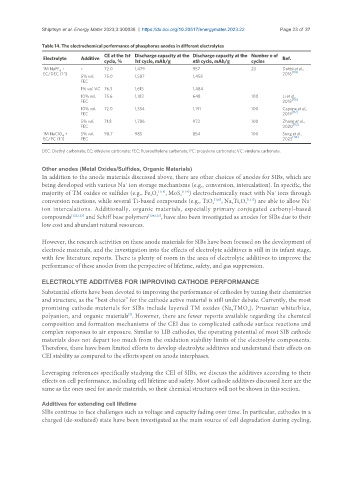
               Table 14. The electrochemical performance of phosphorus anodes in different electrolytes
                                    CE at the 1st  Discharge capacity at the  Discharge capacity at the  Number n of
                Electrolyte  Additive                                                           Ref.
                                    cycle, %  1st cycle, mAh/g    nth cycle, mAh/g    cycles
                1M NaPF  +   -      72.0      1,479               957                 23        Dahbi et al.,
                     6                                                                             [114]
                EC/DEC (1:1)                                                                    2016
                            5% vol.   75.0    1,587               1,458
                            FEC
                            1% vol. VC 76.3   1,615               1,484
                            10% vol.   75.6   1,183               648                 100       Li et al.,
                                                                                                   [115]
                            FEC                                                                 2018
                            10% vol.   72.0   1,354               1,191               100       Capone et al.,
                            FEC                                                                 2019 [117]
                            5% vol.   71.8    1,786               972                 100       Zhang et al.,
                                                                                                    [112]
                            FEC                                                                 2020
                1M NaClO  +   5% vol.   98.7  985                 854                 100       Song et al.,
                      4
                EC/PC (1:1)  FEC                                                                2023 [116]
               DEC: Diethyl carbonate; EC: ethylene carbonate; FEC: fluoroethylene carbonate; PC: propylene carbonate; VC: vinylene carbonate.


               Other anodes (Metal Oxides/Sulfides, Organic Materials)
               In addition to the anode materials discussed above, there are other choices of anodes for SIBs, which are
               being developed with various Na  ion storage mechanisms (e.g., conversion, intercalation). In specific, the
                                           +
               majority of TM oxides or sulfides (e.g., Fe O 3 [118] , MoS 2 [119] ) electrochemically react with Na  ions through
                                                                                             +
                                                    2
               conversion reactions, while several Ti-based compounds (e.g., TiO 2 [120] , Na Ti O 7 [121] ) are able to allow Na
                                                                                                         +
                                                                               2
                                                                                  3
               ion intercalations. Additionally, organic materials, especially primary conjugated carbonyl-based
               compounds [122,123]  and Schiff base polymers [124,125] , have also been investigated as anodes for SIBs due to their
               low cost and abundant natural resources.
               However, the research activities on these anode materials for SIBs have been focused on the development of
               electrode materials, and the investigation into the effects of electrolyte additives is still in its infant stage,
               with few literature reports. There is plenty of room in the area of electrolyte additives to improve the
               performance of these anodes from the perspective of lifetime, safety, and gas suppression.


               ELECTROLYTE ADDITIVES FOR IMPROVING CATHODE PERFORMANCE
               Substantial efforts have been devoted to improving the performance of cathodes by tuning their chemistries
               and structure, as the “best choice” for the cathode active material is still under debate. Currently, the most
               promising cathode materials for SIBs include layered TM oxides (Na TMO ), Prussian white/blue,
                                                                               x
                                                                                     2
               polyanion, and organic materials . However, there are fewer reports available regarding the chemical
                                            [7]
               composition and formation mechanisms of the CEI due to complicated cathode surface reactions and
               complex responses to air exposure. Similar to LIB cathodes, the operating potential of most SIB cathode
               materials does not depart too much from the oxidation stability limits of the electrolyte components.
               Therefore, there have been limited efforts to develop electrolyte additives and understand their effects on
               CEI stability as compared to the efforts spent on anode interphases.


               Leveraging references specifically studying the CEI of SIBs, we discuss the additives according to their
               effects on cell performance, including cell lifetime and safety. Most cathode additives discussed here are the
               same as the ones used for anode materials, so their chemical structures will not be shown in this section.

               Additives for extending cell lifetime
               SIBs continue to face challenges such as voltage and capacity fading over time. In particular, cathodes in a
               charged (de-sodiated) state have been investigated as the main source of cell degradation during cycling,

