


Page 164 - Read Online
P. 164
Page 26 of 37          Shipitsyn et al. Energy Mater 2023;3:300038  https://dx.doi.org/10.20517/energymater.2023.22


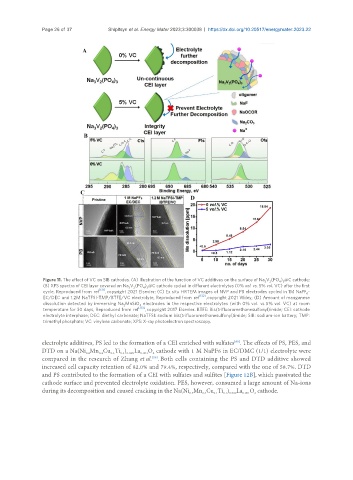
                Figure 11. The effect of VC on SIB cathodes. (A) Illustration of the function of VC additives on the surface of Na V (PO ) @C cathode;
                                                                                          3  2  4 3
                (B) XPS spectra of CEI layer covered on Na V (PO ) @C cathode cycled in different electrolytes (0% vol. vs. 5% vol. VC) after the first
                                            3  2  4 3
                                  [131]
                cycle, Reproduced from  ref  , copyright 2021 Elsevier; (C) Ex situ HRTEM images of NVP and PB electrodes cycled in 1M NaPF -
                                                                                                        6
                                                                    [132]
                EC/DEC and 1.2M NaTFSI-TMP/BTFE/VC electrolyte, Reproduced from  ref  , copyright 2021 Wiley; (D) Amount of manganese
                dissolution detected by immersing Na MnSiO  electrodes in the respective electrolytes (with 0% vol.  vs. 5% vol. VC) at room
                                           2    4
                temperature for 30 days, Reproduced from  ref [133] , copyright 2017 Elsevier. BTFE: Bis(trifluoromethanesulfonyl)imide; CEI: cathode
                electrolyte interphase; DEC: diethyl carbonate; NaTFSI: sodium bis(trifluoromethanesulfonyl)imide; SIB: sodium-ion battery; TMP:
                trimethyl phosphate; VC: vinylene carbonate; XPS: X-ray photoelectron spectroscopy.
               electrolyte additives, PS led to the formation of a CEI enriched with sulfates . The effects of PS, PES, and
                                                                                [69]
               DTD on a Na(Ni Mn Cu Ti )      La 0.001 O  cathode with 1 M NaPF6 in EC/DMC (1/1) electrolyte were
                                          0.1 0.999
                                                     2
                              0.4
                                  0.4
                                      0.1
               compared in the research of Zhang et al. . Both cells containing the PS and DTD additive showed
                                                    [59]
               increased cell capacity retention of 82.0% and 79.4%, respectively, compared with the one of 58.7%. DTD
               and PS contributed to the formation of a CEI with sulfates and sulfites [Figure 12B], which passivated the
               cathode surface and prevented electrolyte oxidation. PES, however, consumed a large amount of Na-ions
               during its decomposition and caused cracking in the Na(Ni Mn Cu Ti ) La O  cathode.
                                                                                   0.001
                                                                                       2
                                                                     0.4
                                                                 0.4
                                                                            0.1 0.999
                                                                         0.1

