


Page 169 - Read Online
P. 169
Shipitsyn et al. Energy Mater 2023;3:300038  https://dx.doi.org/10.20517/energymater.2023.22  Page 31 of 37


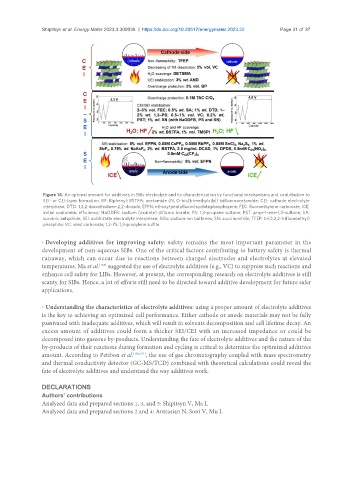
                Figure 14. An optimal amount for additives in SIBs electrolyte and its characterization by functional mechanisms and contribution to
                SEI- or CEI-layer formation. BP: Biphenyl; BSTFA: acetamide (N, O-bis(trimethylsilyl) trifluoroacetamide; CEI: cathode electrolyte
                interphase; DTD: 1,3,2-dioxathiolane-2,2-dioxide; EFPN: ethoxy(pentafluoro)cyclotriphosphazene; FEC: fluoroethylene carbonate; ICE:
                initial coulombic efficiency; NaODFB: sodium (oxalate) difluoro borate; PS: 1,3-propane sultone; PST: prop-1-ene-1,3-sultone; SA:
                succinic anhydride; SEI: solid-state electrolyte interphase; SIBs: sodium-ion batteries; SN: succinonitrile; TFEP: tri(2,2,2-trifluoroethyl)
                phosphite; VC: vinyl carbonate; 1,3-PS: 1,3-propylene sulfite.

               ·  Developing additives for improving safety: safety remains the most important parameter in the
               development of non-aqueous SIBs. One of the critical factors contributing to battery safety is thermal
               runaway, which can occur due to reactions between charged electrodes and electrolytes at elevated
               temperatures. Ma et al.  suggested the use of electrolyte additives (e.g., VC) to suppress such reactions and
                                  [148]
               enhance cell safety for LIBs. However, at present, the corresponding research on electrolyte additives is still
               scanty for SIBs. Hence, a lot of efforts still need to be directed toward additive development for future safer
               applications.


               ·  Understanding the characteristics of electrolyte additives: using a proper amount of electrolyte additives
               is the key to achieving an optimized cell performance. Either cathode or anode materials may not be fully
               passivated with inadequate additives, which will result in solvents decomposition and cell lifetime decay. An
               excess amount of additives could form a thicker SEI/CEI with an increased impedance or could be
               decomposed into gaseous by-products. Understanding the fate of electrolyte additives and the nature of the
               by-products of their reactions during formation and cycling is critical to determine the optimized additives
               amount. According to Petibon et al. [150,151] , the use of gas chromatography coupled with mass spectrometry
               and thermal conductivity detector (GC-MS/TCD) combined with theoretical calculations could reveal the
               fate of electrolyte additives and understand the way additives work.


               DECLARATIONS
               Authors’ contributions
               Analyzed data and prepared sections 1, 3, and 5: Shipitsyn V, Ma L
               Analyzed data and prepared sections 2 and 4: Antrasian N, Soni V, Mu L

