


Page 165 - Read Online
P. 165
Shipitsyn et al. Energy Mater 2023;3:300038  https://dx.doi.org/10.20517/energymater.2023.22  Page 27 of 37


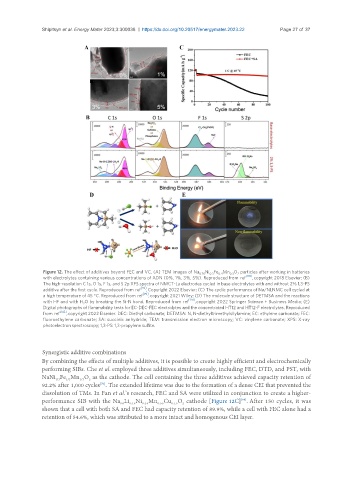
                Figure 12. The effect of additives beyond FEC and VC. (A) TEM images of Na  Ni Fe Mn O  particles after working in batteries
                                                                    0.76  0.3  0.4  0.3  2
                with electrolytes containing various concentrations of ADN (0%, 1%, 3%, 5%). Reproduced from  ref [135] , copyright 2018 Elsevier; (B)
                The high-resolution C 1s, O 1s, F 1s, and S 2p XPS spectra of NMCT-La electrodes cycled in base electrolytes with and without 2% 1,3-PS
                additive after the first cycle. Reproduced from ref [59] , Copyright 2022 Elsevier; (C) The cyclic performance of Na/NLNMC cell cycled at
                a high temperature of 45 °C. Reproduced from ref [99] , copyright 2021 Wiley; (D) The molecule structure of DETMSA and the reactions
                                                                 [141]
                with HF and with H O by breaking the Si-N bond. Reproduced from  ref  , copyright 2022 Springer Science + Business Media; (E)
                             2
                Digital photographs of flammability tests for EC-DEC-FEC electrolytes and the concentrated HT12 and HT12-F electrolytes. Reproduced
                     [142]
                from ref  , copyright 2022 Elsevier. DEC: Diethyl carbonate; DETMSA: N, N-diethyltrimethylsilylamine; EC: ethylene carbonate; FEC:
                fluoroethylene carbonate; SA: succinic anhydride; TEM: transmission electron microscopy; VC: vinylene carbonate; XPS: X-ray
                photoelectron spectroscopy; 1,3-PS: 1,3-propylene sulfite.

               Synergistic additive combinations
               By combining the effects of multiple additives, it is possible to create highly efficient and electrochemically
               performing SIBs. Che et al. employed three additives simultaneously, including FEC, DTD, and PST, with
               NaNi Fe Mn O  as the cathode. The cell containing the three additives achieved capacity retention of
                       1/3
                            1/3
                               2
                    1/3
                                   [70]
               92.2% after 1,000 cycles . The extended lifetime was due to the formation of a dense CEI that prevented the
               dissolution of TMs. In Fan et al.’s research, FEC and SA were utilized in conjunction to create a higher-
               performance SIB with the Na Li Ni Mn Cu O  cathode [Figure 12C] . After 150 cycles, it was
                                                                                  [99]
                                                           0.15
                                                               2
                                                      0.55
                                          0.6
                                             0.15
                                                 0.15
               shown that a cell with both SA and FEC had capacity retention of 89.9%, while a cell with FEC alone had a
               retention of 54.6%, which was attributed to a more intact and homogenous CEI layer.

