


Page 160 - Read Online
P. 160
Page 22 of 37          Shipitsyn et al. Energy Mater 2023;3:300038  https://dx.doi.org/10.20517/energymater.2023.22

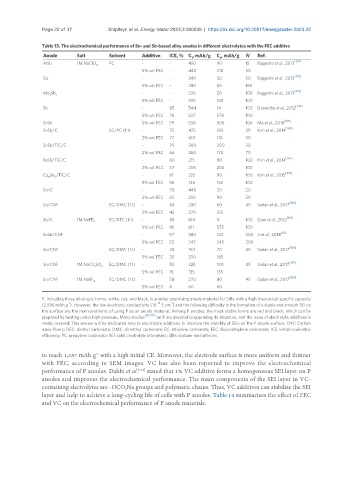
               Table 13. The electrochemical performance of Sn- and Sb-based alloy anodes in different electrolytes with the FEC additive
                Anode      Salt       Solvent    Additive  ICE, % C , mAh/g  C , mAh/g  N  Ref.
                                                                  1
                                                                           n
                AlSb       1M NaClO 4  PC        -        -      450      90        15  Baggetto et al., 2013 [101]
                                                 5% vol. FEC  -  440      210       50
                                                                                                    [102]
                Ge                               -        -      340      30        50  Baggetto et al., 2013
                                                 5% vol. FEC  -  280      50        150
                                                                                                    [103]
                Mo Sb 7                          -        -      330      20        100  Baggetto et al., 2013
                  3
                                                 5% vol. FEC  -  330      150       100
                                                                                                     [104]
                Sb                               -        65     544      14        100  Darwiche et al., 2012
                                                 5% vol. FEC  76  537     576       100
                                                                                                 [105]
                SnSb                             5% vol. FEC  59  536     506       100  Ma et al., 2018
                SnSb/C                EC/PC (1:1)  -      75     475      105       30  Kim et al., 2014 [106]
                                                 2% vol. FEC  77  610     110       30
                SnSb/TiC/C                       -        70     300      200       30
                                                 2% vol. FEC  66  260     170       70
                                                                                                 [107]
                FeSb/TiC/C                       -        60     215      90        100  Kim et al., 2014
                                                 2% vol. FEC  57  205     204       100
                                                                                                 [108]
                Cu Sn /TiC/C                     -        61     225      90        100  Kim et al., 2015
                 6
                   5
                                                 2% vol. FEC  56  146     155       100
                Sn/C                             -        70     445      20        20
                                                 2% vol. FEC  65  250     90        50
                                                                                                   [109]
                Sn/CNF                EC/DMC (1:1)  -     68     280      60        45  Sadan et al., 2017
                                                 5% vol. FEC  45  270     155
                                                                                                  [110]
                Sb/C       1M NaPF    EC/DEC (1:1)  -     85     610      0         100  Qian et al., 2012
                                 6
                                                 5% vol. FEC  85  611     575       100
                                                                                                [111]
                SnSb/CNF                         -        57     380      130       200 Ji et al., 2014
                                                 5% vol. FEC  53  347     345       200
                                                                                                   [109]
                Sn/CNF                EC/DMC (1:1)  -     24     150      70        45  Sadan et al., 2017
                                                 5% vol. FEC  30  230     185
                                                                                                   [109]
                Sn/CNF     1M NaCF SO  EC/DMC (1:1)  -    50     325      100       45  Sadan et al., 2017
                                 3  3
                                                 5% vol. FEC  16  135     135
                Sn/CNF     1M NaBF 4  EC/DMC (1:1)  -     58     270      80        45  Sadan et al., 2017 [109]
                                                 5% vol. FEC  8  60       60
               P, including three allotropic forms: white, red, and black, is another promising anode material for SIBs with a high theoretical specific capacity
                                                      -14
                                                           -1
                        -1
               (2,596 mAh g ). However, the low electronic conductivity (10  S cm ) and the following difficulty in the formation of a stable and smooth SEI on
               the surface are the main problems of using P as an anode material. Among P anodes, the most stable forms are red and black, which can be
                                                  [112-117]
               prepared by heating under high pressure. Many studies   on P are devoted to upgrading its structure, and the issue of electrolyte additives is
               rarely covered. This review will be dedicated only to electrolyte additives to improve the stability of SEIs on the P anode surface. CNF: Carbon
               nano-fibers; DEC: diethyl carbonate; DMC: dimethyl carbonate; EC: ethylene carbonate; FEC: fluoroethylene carbonate; ICE: initial coulombic
               efficiency; PC: propylene carbonate; SEI: solid electrolyte interphase; SIBs: sodium-ion batteries.
               to reach 1,587 mAh g  with a high initial CE. Moreover, the electrode surface is more uniform and thinner
                                 -1
               with FEC, according to SEM images. VC has also been reported to improve the electrochemical
                                                [114]
               performance of P anodes. Dahbi et al.  stated that 1% VC additive forms a homogeneous SEI layer on P
               anodes and improves the electrochemical performance. The main components of the SEI layer in VC-
               containing electrolytes are -OCO Na groups and polymeric chains. Thus, VC additives can stabilize the SEI
                                           2
               layer and help to achieve a long-cycling life of cells with P anodes. Table 14 summarizes the effect of FEC
               and VC on the electrochemical performance of P anode materials.

