


Page 157 - Read Online
P. 157
Shipitsyn et al. Energy Mater 2023;3:300038  https://dx.doi.org/10.20517/energymater.2023.22  Page 19 of 37

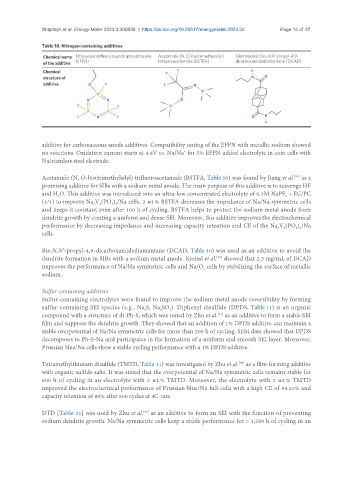
               Table 10. Nitrogen-containing additives

                Chemical name  Ethoxy(pentafluoro)cyclotriphosphazene   Acetamide (N, O-bis(trimethylsilyl)   Diamondoid (bis-N,N’-propyl-4,9-
                of the additive  (EFPN)               trifluoroacetamide (BSTFA)  dicarboxamidediamantane (DCAD)
                Chemical
                structure of
                additive


               additive for carbonaceous anode additives. Compatibility testing of the EFPN with metallic sodium showed
               no reactions. Oxidation current starts at 4.8V vs. Na/Na  for 5% EFPN-added electrolyte in coin cells with
                                                               +
               Na/stainless steel electrode.


                                                                                                    [89]
               Acetamide (N, O-bis(trimethylsilyl) trifluoroacetamide (BSTFA, Table 10) was found by Jiang et al.  as a
               promising additive for SIBs with a sodium metal anode. The main purpose of this additive is to scavenge HF
               and H O. This additive was introduced into an ultra-low concentrated electrolyte of 0.3M NaPF  + EC/PC
                     2
                                                                                                 6
               (1/1) to improve Na V (PO ) /Na cells. 2 wt.% BSTFA decreases the impedance of Na/Na symmetric cells
                                       4 3
                                 3
                                   2
               and keeps it constant even after 100 h of cycling. BSTFA helps to protect the sodium metal anode from
               dendrite growth by creating a uniform and dense SEI. Moreover, this additive improves the electrochemical
               performance by decreasing impedance and increasing capacity retention and CE of the Na V (PO ) /Na
                                                                                                     4 3
                                                                                               3
                                                                                                 2
               cells.
               Bis-N,N’-propyl-4,9-dicarboxamidediamantane (DCAD, Table 10) was used as an additive to avoid the
               dendrite formation in SIBs with a sodium metal anode. Kreissl et al.  showed that 2.5 mg/mL of DCAD
                                                                          [90]
               improves the performance of Na/Na symmetric cells and Na/O  cells by stabilizing the surface of metallic
                                                                      2
               sodium.
               Sulfur-containing additives
               Sulfur-containing electrolytes were found to improve the sodium metal anode reversibility by forming
               sulfur-containing SEI species (e.g., Na S, Na SO ). Diphenyl disulfide (DPDS, Table 11) is an organic
                                                  2
                                                       2
                                                          3
               compound with a structure of di-Ph-S, which was tested by Zhu et al.  as an additive to form a stable SEI
                                                                          [91]
               film and suppress the dendrite growth. They showed that an addition of 1% DPDS additive can maintain a
               stable overpotential of Na/Na symmetric cells for more than 200 h of cycling. SEM data showed that DPDS
               decomposes to Ph-S-Na and participates in the formation of a uniform and smooth SEI layer. Moreover,
               Prussian blue/Na cells show a stable cycling performance with a 1% DPDS additive.

               Tetramethylthiuram disulfide (TMTD, Table 11) was investigated by Zhu et al.  as a film-forming additive
                                                                                  [92]
               with organic sulfide salts. It was stated that the overpotential of Na/Na symmetric cells remains stable for
               600 h of cycling in an electrolyte with 2 wt.% TMTD. Moreover, the electrolyte with 2 wt.% TMTD
               improved the electrochemical performance of Prussian blue/Na full-cells with a high CE of 94.25% and
               capacity retention of 80% after 600 cycles at 4C-rate.


                                                 [93]
               DTD [Table 11] was used by Zhu et al.  as an additive to form an SEI with the function of preventing
               sodium dendrite growth. Na/Na symmetric cells keep a stable performance for > 1,350 h of cycling in an

