


Page 153 - Read Online
P. 153
Shipitsyn et al. Energy Mater 2023;3:300038  https://dx.doi.org/10.20517/energymater.2023.22  Page 15 of 37

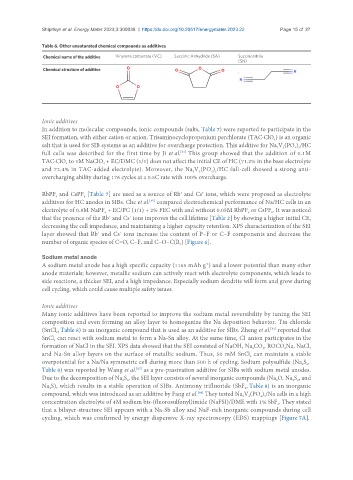
               Table 6. Other unsaturated chemical compounds as additives
                Chemical name of the additive  Vinylene carbonate (VC)  Succinic Anhydride (SA)  Succinonitrile
                                                                                 (SN)
                Chemical structure of additive


               Ionic additives
               In addition to molecular compounds, ionic compounds (salts, Table 7) were reported to participate in the
               SEI formation, with either cation or anion. Trisaminocyclopropenium perchlorate (TAC·ClO ) is an organic
                                                                                             4
               salt that is used for SIB systems as an additive for overcharge protection. This additive for Na V (PO ) /HC
                                                                                                2
                                                                                              3
                                                                                                    4 3
               full cells was described for the first time by Ji et al.  This group showed that the addition of 0.1M
                                                              [81]
               TAC·ClO  to 1M NaClO  + EC/DMC (1/1) does not affect the initial CE of HC (71.2% in the base electrolyte
                                    4
                       4
               and 72.4% in TAC-added electrolyte). Moreover, the Na V (PO ) /HC full-cell showed a strong anti-
                                                                  3
                                                                        4 3
                                                                    2
               overcharging ability during 176 cycles at a 0.5C rate with 100% overcharge.
               RbPF  and CsPF  [Table 7] are used as a source of Rb  and Cs  ions, which were proposed as electrolyte
                                                              +
                                                                     +
                             6
                    6
                                                   [65]
               additives for HC anodes in SIBs. Che et al.  compared electrochemical performance of Na/HC cells in an
               electrolyte of 0.8M NaPF  + EC/PC (1/1) + 2% FEC with and without 0.05M RbPF  or CsPF . It was noticed
                                                                                     6
                                    6
                                                                                            6
               that the presence of the Rb  and Cs  ions improves the cell lifetime [Table 2] by showing a higher initial CE,
                                             +
                                      +
               decreasing the cell impedance, and maintaining a higher capacity retention. XPS characterization of the SEI
               layer showed that Rb  and Cs  ions increase the content of P−F or C−F components and decrease the
                                  +
                                         +
               number of organic species of C=O, C−F, and C−O−C(R ) [Figure 6].
                                                              1
               Sodium metal anode
               A sodium metal anode has a high specific capacity (1165 mAh g ) and a lower potential than many other
                                                                      -1
               anode materials; however, metallic sodium can actively react with electrolyte components, which leads to
               side reactions, a thicker SEI, and a high impedance. Especially sodium dendrite will form and grow during
               cell cycling, which could cause multiple safety issues.
               Ionic additives
               Many ionic additives have been reported to improve the sodium metal reversibility by tuning the SEI
               composition and even forming an alloy layer to homogenize the Na deposition behavior. Tin chloride
               (SnCl , Table 8) is an inorganic compound that is used as an additive for SIBs. Zheng et al.  reported that
                                                                                            [82]
                    2
               SnCl  can react with sodium metal to form a Na-Sn alloy. At the same time, Cl  anion participates in the
                                                                                    -
                   2
               formation of NaCl in the SEI. XPS data showed that the SEI consisted of NaOH, Na CO , ROCO Na, NaCl,
                                                                                                 2
                                                                                      2
                                                                                          3
               and Na-Sn alloy layers on the surface of metallic sodium. Thus, 50 mM SnCl  can maintain a stable
                                                                                     2
               overpotential for a Na/Na symmetric cell during more than 500 h of cycling. Sodium polysulfide (Na S ,
                                                                                                       2 6
                                               [83]
               Table 8) was reported by Wang et al.  as a pre-passivation additive for SIBs with sodium metal anodes.
               Due to the decomposition of Na S , the SEI layer consists of several inorganic compounds (Na O, Na S , and
                                          2 6
                                                                                                    2 2
                                                                                              2
               Na S), which results in a stable operation of SIBs. Antimony trifluoride (SbF , Table 8) is an inorganic
                                                                                    3
                  2
               compound, which was introduced as an additive by Fang et al.  They tested Na V (PO ) /Na cells in a high
                                                                    [84]
                                                                                         4 3
                                                                                     2
                                                                                   3
               concentration electrolyte of 4M sodium bis-(fluorosulfonyl)imide (NaFSI)/DME with 1% SbF . They stated
                                                                                               3
               that a bilayer-structure SEI appears with a Na-Sb alloy and NaF-rich inorganic compounds during cell
               cycling, which was confirmed by energy dispersive X-ray spectroscopy (EDS) mappings [Figure 7A].

