


Page 151 - Read Online
P. 151
Shipitsyn et al. Energy Mater 2023;3:300038  https://dx.doi.org/10.20517/energymater.2023.22  Page 13 of 37

               Table 5. Phosphorus-containing additives
                Chemical name of the additive  Ethoxy(pentafluoro)cyclotriphosphazene (EFPN)  Tris(trimethylsilyl) phosphite (TMSPi)
                Chemical structure of additive


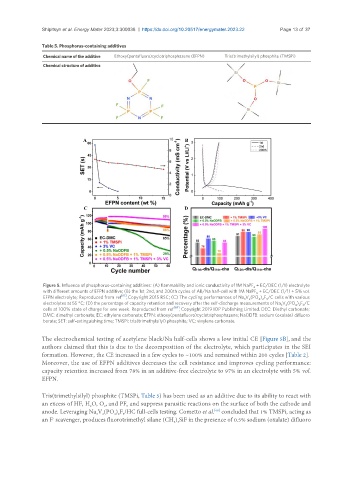
                Figure 5. Influence of phosphorus-containing additives: (A) flammability and ionic conductivity of 1M NaPF  + EC/DEC (1/1) electrolyte
                                                                                       6
                with different amounts of EFPN additive; (B) the 1st 2nd, and 200th cycles of AB/Na half-cell with 1M NaPF  + EC/DEC (1/1) + 5% vol.
                                                  ,
                                                                                       6
                EFPN electrolyte; Reproduced from  ref [61] , Copyright 2015 RSC; (C) The cycling performances of Na V (PO ) F /C cells with various
                                                                                     2
                                                                                        4 2 3
                                                                                   3
                electrolytes at 55 °C; (D) the percentage of capacity retention and recovery after the self-discharge measurements of Na V (PO ) F /C
                                                                                                     4 2 3
                                                                                                 2
                                                                                                3
                cells at 100% state of charge for one week. Reproduced from  ref [68] , Copyright 2019 IOP Publishing Limited. DEC: Diethyl carbonate;
                DMC: dimethyl carbonate; EC: ethylene carbonate; EFPN: ethoxy(pentafluoro)cyclotriphosphazene; NaODFB: sodium (oxalate) difluoro
                borate; SET: self-extinguishing time; TMSPi: tris(trimethylsilyl) phosphite; VC: vinylene carbonate.
               The electrochemical testing of acetylene black/Na half-cells shows a low initial CE [Figure 5B], and the
               authors claimed that this is due to the decomposition of the electrolyte, which participates in the SEI
               formation. However, the CE increased in a few cycles to ~100% and remained within 200 cycles [Table 2].
               Moreover, the use of EFPN additives decreases the cell resistance and improves cycling performance:
               capacity retention increased from 78% in an additive-free electrolyte to 97% in an electrolyte with 5% vol.
               EFPN.
               Tris(trimethylsilyl) phosphite (TMSPi, Table 5) has been used as an additive due to its ability to react with
               an excess of HF, H O, O , and PF  and suppress parasitic reactions on the surface of both the cathode and
                               2
                                    2
                                            5
               anode. Leveraging Na V (PO ) F /HC full-cells testing. Cometto et al.  concluded that 1% TMSPi, acting as
                                                                         [68]
                                   2
                                 3
                                        4 2 3
                   -
               an F  scavenger, produces fluorotrimethyl silane (CH ) SiF in the presence of 0.5% sodium (oxalate) difluoro
                                                            3 3

