


Page 154 - Read Online
P. 154
Page 16 of 37          Shipitsyn et al. Energy Mater 2023;3:300038  https://dx.doi.org/10.20517/energymater.2023.22

               Table 7. Ionic additives

                Chemical name of the additive Trisaminocyclopropenium perchlorate (TAC·ClO )  RbPF 6  CsPF 6
                                                                   4
                Chemical structure of additive


               Table 8. Ionic additives
                Chemical name  Tin Chloride (SnCl )  Sodium Polysulfide (Na S )  Antimony trifluoride (SbF )  Sodium Hexafluoroarsenate
                                      2
                                                          2 6
                                                                                3
                of the additive                                                      (NaAsF )
                                                                                          6
                Chemical
                structure of
                additive


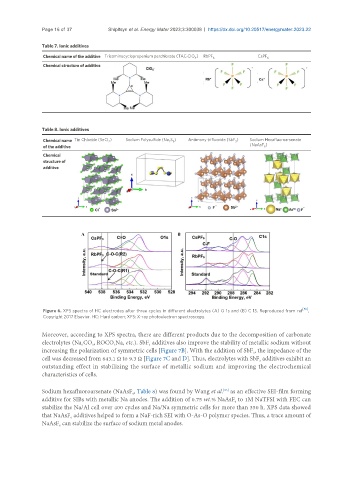
                Figure 6. XPS spectra of HC electrodes after three cycles in different electrolytes (A) O 1s and (B) C 1S. Reproduced from  ref [65] ,
                Copyright 2017 Elsevier. HC: Hard carbon; XPS: X-ray photoelectron spectroscopy.


               Moreover, according to XPS spectra, there are different products due to the decomposition of carbonate
               electrolytes (Na CO , ROCO Na, etc.). SbF  additives also improve the stability of metallic sodium without
                             2
                                                   3
                                       2
                                3
               increasing the polarization of symmetric cells [Figure 7B]. With the addition of SbF , the impedance of the
                                                                                      3
               cell was decreased from 643.1 Ω to 9.3 Ω [Figure 7C and D]. Thus, electrolytes with SbF  additives exhibit an
                                                                                        3
               outstanding effect in stabilizing the surface of metallic sodium and improving the electrochemical
               characteristics of cells.
               Sodium hexafluoroarsenate (NaAsF , Table 8) was found by Wang et al.  as an effective SEI-film forming
                                                                            [85]
                                              6
               additive for SIBs with metallic Na anodes. The addition of 0.75 wt.% NaAsF  to 1M NaTFSI with FEC can
                                                                                6
               stabilize the Na/Al cell over 400 cycles and Na/Na symmetric cells for more than 350 h. XPS data showed
               that NaAsF  additives helped to form a NaF-rich SEI with O-As-O polymer species. Thus, a trace amount of
                         6
               NaAsF  can stabilize the surface of sodium metal anodes.
                     6

