


Page 150 - Read Online
P. 150
Page 12 of 37          Shipitsyn et al. Energy Mater 2023;3:300038  https://dx.doi.org/10.20517/energymater.2023.22

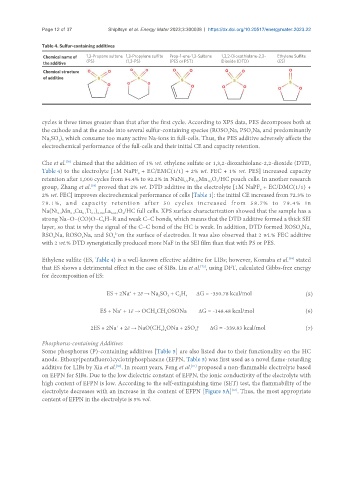
               Table 4. Sulfur-containing additives
                Chemical name of   1,3-Propane sultone  1,3-Propylene sulfite   Prop-1-ene-1,3-Sultone   1,3,2-Dioxathiolane-2,2-  Ethylene Sulfite
                the additive  (PS)         (1,3-PS)       (PES or PST)      Dioxide (DTD)     (ES)
                Chemical structure
                of additive


               cycles is three times greater than that after the first cycle. According to XPS data, PES decomposes both at
               the cathode and at the anode into several sulfur-containing species (ROSO Na, PSO Na, and predominantly
                                                                              2
                                                                                      3
               Na SO ), which consume too many active Na-ions in full-cells. Thus, the PES additive adversely affects the
                     3
                  2
               electrochemical performance of the full-cells and their initial CE and capacity retention.
                       [70]
               Che et al.  claimed that the addition of 1% wt. ethylene sulfate or 1,3,2-dioxathiolane-2,2-dioxide (DTD,
               Table 4) to the electrolyte [1M NaPF  + EC/EMC(1/1) + 2% wt. FEC + 1% wt. PES] increased capacity
                                                6
               retention after 1,000 cycles from 84.4% to 92.2% in NaNi Fe Mn O /HC pouch cells. In another research
                                                               1/3
                                                                          2
                                                                       1/3
                                                                  1/3
               group, Zhang et al.  proved that 2% wt. DTD additive in the electrolyte [1M NaPF  + EC/DMC(1/1) +
                                [59]
                                                                                         6
               2% wt. FEC] improves electrochemical performance of cells [Table 1]: the initial CE increased from 72.3% to
               7 9 . 1 % ,   a n d   c a p a c i t y   r e t e n t i o n   a f t e r   5 0   c y c l e s   i n c r e a s e d   f r o m   5 8 . 7 %   t o   7 9 . 4 %   i n
               Na(Ni Mn Cu Ti ) La O /HC full cells. XPS surface characterization showed that the sample has a
                         0.4
                    0.4
                                          2
                                0.1 0.999
                             0.1
                                      0.001
               strong Na−O−(CO)O−C H−R and weak C−C bonds, which means that the DTD additive formed a thick SEI
                                    2
               layer, so that is why the signal of the C−C bond of the HC is weak. In addition, DTD formed ROSO Na,
                                                                                                      2
               RSO Na, ROSO Na, and SO on the surface of electrodes. It was also observed that 2 wt.% FEC additive
                                        2-
                                       4
                   2
                             3
               with 2 wt.% DTD synergistically produced more NaF in the SEI film than that with PS or PES.
                                                                                                  [39]
               Ethylene sulfite (ES, Table 4) is a well-known effective additive for LIBs; however, Komaba et al.  stated
               that ES shows a detrimental effect in the case of SIBs. Liu et al. , using DFT, calculated Gibbs-free energy
                                                                     [72]
               for decomposition of ES:
                                     ES + 2Na  + 2ē → Na SO  + C H 4            ΔG = -350.78 kcal/mol   (5)
                                             +
                                                          3
                                                      2
                                                              2
                                         +
                                   ES + Na  + 1ē → OCH CH OSONa        ΔG = -148.48 kcal/mol                                   (6)
                                                         2
                                                     2
                                2ES + 2Na  + 2ē → NaO(CH ) ONa + 2SO ↑        ΔG = -339.83 kcal/mol     (7)
                                        +
                                                       2 4
                                                                   2
               Phosphorus-containing Additives
               Some phosphorus (P)-containing additives [Table 5] are also listed due to their functionality on the HC
               anode. Ethoxy(pentafluoro)cyclotriphosphazene (EFPN, Table 5) was first used as a novel flame-retarding
                                        [80]
                                                                 [61]
               additive for LIBs by Xia et al. . In recent years, Feng et al.  proposed a non-flammable electrolyte based
               on EFPN for SIBs. Due to the low dielectric constant of EFPN, the ionic conductivity of the electrolyte with
               high content of EFPN is low. According to the self-extinguishing time (SET) test, the flammability of the
                                                                               [61]
               electrolyte decreases with an increase in the content of EFPN [Figure 5A] . Thus, the most appropriate
               content of EFPN in the electrolyte is 5% vol.

