


Page 158 - Read Online
P. 158
Page 20 of 37          Shipitsyn et al. Energy Mater 2023;3:300038  https://dx.doi.org/10.20517/energymater.2023.22

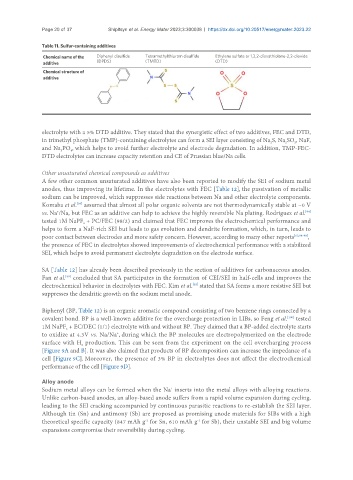
               Table 11. Sulfur-containing additives
                Chemical name of the   Diphenyl disulfide   Tetramethylthiuram disulfide   Ethylene sulfate or 1,3,2-dioxathiolane-2,2-dioxide
                additive          (DPDS)          (TMTD)                  (DTD)
                Chemical structure of
                additive


               electrolyte with a 5% DTD additive. They stated that the synergistic effect of two additives, FEC and DTD,
               in trimethyl phosphate (TMP)-containing electrolytes can form a SEI layer consisting of Na S, Na SO , NaF,
                                                                                            2
                                                                                                    3
                                                                                                 2
               and Na PO , which helps to avoid further electrolyte and electrode degradation. In addition, TMP-FEC-
                         4
                     3
               DTD electrolytes can increase capacity retention and CE of Prussian blue/Na cells.
               Other unsaturated chemical compounds as additives
               A few other common unsaturated additives have also been reported to modify the SEI of sodium metal
               anodes, thus improving its lifetime. In the electrolytes with FEC [Table 12], the passivation of metallic
               sodium can be improved, which suppresses side reactions between Na and other electrolyte components.
               Komaba et al.  assumed that almost all polar organic solvents are not thermodynamically stable at ~0 V
                           [39]
               vs. Na /Na, but FEC as an additive can help to achieve the highly reversible Na plating. Rodriguez et al.
                                                                                                        [94]
                    +
               tested 1M NaPF  + PC/FEC (98/2) and claimed that FEC improves the electrochemical performance and
                             6
               helps to form a NaF-rich SEI but leads to gas evolution and dendrite formation, which, in turn, leads to
               poor contact between electrodes and more safety concern. However, according to many other reports [63,94-98] ,
               the presence of FEC in electrolytes showed improvements of electrochemical performance with a stabilized
               SEI, which helps to avoid permanent electrolyte degradation on the electrode surface.


               SA [Table 12] has already been described previously in the section of additives for carbonaceous anodes.
                       [99]
               Fan et al.  concluded that SA participates in the formation of CEI/SEI in half-cells and improves the
               electrochemical behavior in electrolytes with FEC. Kim et al.  stated that SA forms a more resistive SEI but
                                                                  [63]
               suppresses the dendritic growth on the sodium metal anode.
               Biphenyl (BP, Table 12) is an organic aromatic compound consisting of two benzene rings connected by a
                                                                                                  [100]
               covalent bond. BP is a well-known additive for the overcharge protection in LIBs, so Feng et al.  tested
               1M NaPF  + EC/DEC (1/1) electrolyte with and without BP. They claimed that a BP-added electrolyte starts
                       6
               to oxidize at 4.3V vs. Na/Na , during which the BP molecules are electropolymerized on the electrode
                                        +
               surface with H  production. This can be seen from the experiment on the cell overcharging process
                             2
               [Figure 9A and B]. It was also claimed that products of BP decomposition can increase the impedance of a
               cell [Figure 9C]. Moreover, the presence of 3% BP in electrolytes does not affect the electrochemical
               performance of the cell [Figure 9D].


               Alloy anode
               Sodium metal alloys can be formed when the Na  inserts into the metal alloys with alloying reactions.
                                                           +
               Unlike carbon-based anodes, an alloy-based anode suffers from a rapid volume expansion during cycling,
               leading to the SEI cracking accompanied by continuous parasitic reactions to re-establish the SEI layer.
               Although tin (Sn) and antimony (Sb) are proposed as promising anode materials for SIBs with a high
               theoretical specific capacity (847 mAh g  for Sn, 610 mAh g  for Sb), their unstable SEI and big volume
                                                  -1
                                                                    -1
               expansions compromise their reversibility during cycling.

