


Page 134 - Read Online
P. 134
Shi et al. Energy Mater 2023;3:300036  https://dx.doi.org/10.20517/energymater.2023.27  Page 11 of 14


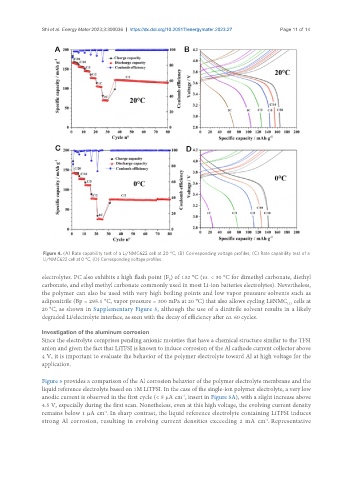
                Figure 4. (A) Rate capability test of a Li/NMC622 cell at 20 °C, (B) Corresponding voltage profiles, (C) Rate capability test of a
                Li/NMC622 cell at 0 °C, (D) Corresponding voltage profiles.


               electrolytes. PC also exhibits a high flash point (F ) of 132 °C (vs. < 30 °C for dimethyl carbonate, diethyl
                                                          p
               carbonate, and ethyl methyl carbonate commonly used in most Li-ion batteries electrolytes). Nevertheless,
               the polymer can also be used with very high boiling points and low vapor pressure solvents such as
               adiponitrile (Bp = 295.1 °C, vapor pressure = 300 mPa at 20 °C) that also allows cycling LiǁNMC  cells at
                                                                                                  111
               20 °C, as shown in Supplementary Figure 5, although the use of a dinitrile solvent results in a likely
               degraded Li/electrolyte interface, as seen with the decay of efficiency after ca. 60 cycles.

               Investigation of the aluminum corrosion
               Since the electrolyte comprises pending anionic moieties that have a chemical structure similar to the TFSI
               anion and given the fact that LiTFSI is known to induce corrosion of the Al cathode current collector above
               4 V, it is important to evaluate the behavior of the polymer electrolyte toward Al at high voltage for the
               application.

               Figure 5 provides a comparison of the Al corrosion behavior of the polymer electrolyte membrane and the
               liquid reference electrolyte based on 1M LiTFSI. In the case of the single-ion polymer electrolyte, a very low
               anodic current is observed in the first cycle (< 5 µA cm , insert in Figure 5A), with a slight increase above
                                                               -2
               4.5 V, especially during the first scan. Nonetheless, even at this high voltage, the evolving current density
               remains below 1 µA cm . In sharp contrast, the liquid reference electrolyte containing LiTFSI induces
                                    -2
                                                                                          -2
               strong Al corrosion, resulting in evolving current densities exceeding 2 mA cm . Representative

