


Page 64 - Read Online
P. 64
Page 8 of 19                  Rinaldi et al. Vessel Plus 2024;8:21  https://dx.doi.org/10.20517/2574-1209.2023.65


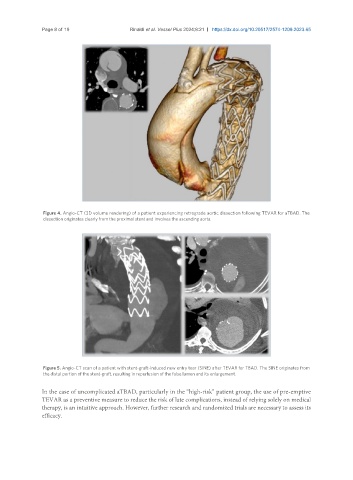
                Figure 4. Angio-CT (3D volume rendering) of a patient experiencing retrograde aortic dissection following TEVAR for aTBAD. The
                dissection originates clearly from the proximal stent and involves the ascending aorta.


                Figure 5. Angio-CT scan of a patient with stent-graft-induced new entry tear (SINE) after TEVAR for TBAD. The SINE originates from
                the distal portion of the stent-graft, resulting in reperfusion of the false lumen and its enlargement.


               In the case of uncomplicated aTBAD, particularly in the “high-risk” patient group, the use of pre-emptive
               TEVAR as a preventive measure to reduce the risk of late complications, instead of relying solely on medical
               therapy, is an intuitive approach. However, further research and randomized trials are necessary to assess its
               efficacy.

