


Page 63 - Read Online
P. 63
Rinaldi et al. Vessel Plus 2024;8:21  https://dx.doi.org/10.20517/2574-1209.2023.65   Page 7 of 19


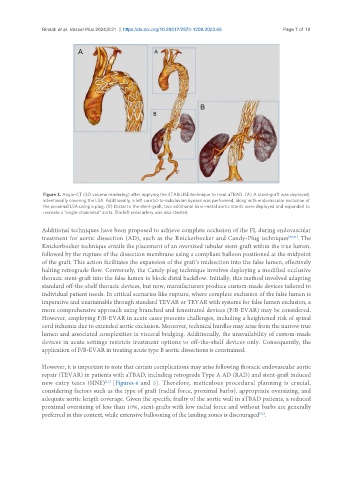
                Figure 3. Angio-CT (3D volume rendering) after applying the STABILISE technique to treat aTBAD. (A) A stent-graft was deployed,
                intentionally covering the LSA. Additionally, a left carotid-to-subclavian bypass was performed, along with endovascular exclusion of
                the proximal LSA using a plug. (B) Distal to the stent-graft, two additional bare-metal aortic stents were deployed and expanded to
                recreate a “single-channeled” aorta. The left renal artery was also stented.


               Additional techniques have been proposed to achieve complete occlusion of the FL during endovascular
               treatment for aortic dissection (AD), such as the Knickerbocker and Candy-Plug techniques [30,31] . The
               Knickerbocker technique entails the placement of an oversized tubular stent-graft within the true lumen,
               followed by the rupture of the dissection membrane using a compliant balloon positioned at the midpoint
               of the graft. This action facilitates the expansion of the graft's midsection into the false lumen, effectively
               halting retrograde flow. Conversely, the Candy-plug technique involves deploying a modified occlusive
               thoracic stent-graft into the false lumen to block distal backflow. Initially, this method involved adapting
               standard off-the-shelf thoracic devices, but now, manufacturers produce custom-made devices tailored to
               individual patient needs. In critical scenarios like rupture, where complete exclusion of the false lumen is
               imperative and unattainable through standard TEVAR or TEVAR with systems for false lumen exclusion, a
               more comprehensive approach using branched and fenestrated devices (F/B-EVAR) may be considered.
               However, employing F/B-EVAR in acute cases presents challenges, including a heightened risk of spinal
               cord ischemia due to extended aortic exclusion. Moreover, technical hurdles may arise from the narrow true
               lumen and associated complexities in visceral bridging. Additionally, the unavailability of custom-made
               devices in acute settings restricts treatment options to off-the-shelf devices only. Consequently, the
               application of F/B-EVAR in treating acute type B aortic dissections is constrained.

               However, it is important to note that certain complications may arise following thoracic endovascular aortic
               repair (TEVAR) in patients with aTBAD, including retrograde Type A AD (RAD) and stent-graft induced
               new entry tears (SINE)  [Figures 4 and 5]. Therefore, meticulous procedural planning is crucial,
                                    [11]
               considering factors such as the type of graft (radial force, proximal barbs), appropriate oversizing, and
               adequate aortic length coverage. Given the specific frailty of the aortic wall in aTBAD patients, a reduced
               proximal oversizing of less than 10%, stent-grafts with low radial force and without barbs are generally
                                                                                        [32]
               preferred in this context, while extensive ballooning of the landing zones is discouraged .

