


Page 67 - Read Online
P. 67
Rinaldi et al. Vessel Plus 2024;8:21  https://dx.doi.org/10.20517/2574-1209.2023.65   Page 11 of 19


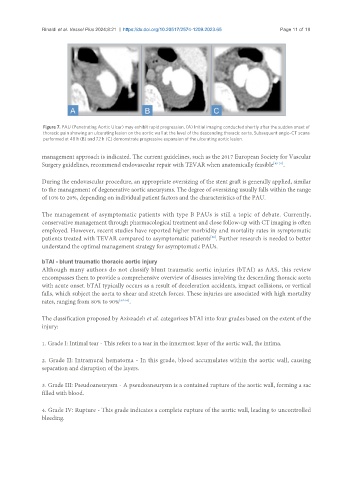
                Figure 7. PAU (Penetrating Aortic Ulcer) may exhibit rapid progression. (A) Initial imaging conducted shortly after the sudden onset of
                thoracic pain showing an ulcerating lesion on the aortic wall at the level of the descending thoracic aorta. Subsequent angio-CT scans
                performed at 48 h (B) and 72 h (C) demonstrate progressive expansion of the ulcerating aortic lesion.

               management approach is indicated. The current guidelines, such as the 2017 European Society for Vascular
               Surgery guidelines, recommend endovascular repair with TEVAR when anatomically feasible [49-51] .

               During the endovascular procedure, an appropriate oversizing of the stent graft is generally applied, similar
               to the management of degenerative aortic aneurysms. The degree of oversizing usually falls within the range
               of 10% to 20%, depending on individual patient factors and the characteristics of the PAU.

               The management of asymptomatic patients with type B PAUs is still a topic of debate. Currently,
               conservative management through pharmacological treatment and close follow-up with CT imaging is often
               employed. However, recent studies have reported higher morbidity and mortality rates in symptomatic
                                                                        [52]
               patients treated with TEVAR compared to asymptomatic patients . Further research is needed to better
               understand the optimal management strategy for asymptomatic PAUs.


               bTAI - blunt traumatic thoracic aortic injury
               Although many authors do not classify blunt traumatic aortic injuries (bTAI) as AAS, this review
               encompasses them to provide a comprehensive overview of diseases involving the descending thoracic aorta
               with acute onset. bTAI typically occurs as a result of deceleration accidents, impact collisions, or vertical
               falls, which subject the aorta to shear and stretch forces. These injuries are associated with high mortality
               rates, ranging from 80% to 90% [53-55] .

               The classification proposed by Azizzadeh et al. categorizes bTAI into four grades based on the extent of the
               injury:

               1. Grade I: Intimal tear - This refers to a tear in the innermost layer of the aortic wall, the intima.


               2. Grade II: Intramural hematoma - In this grade, blood accumulates within the aortic wall, causing
               separation and disruption of the layers.

               3. Grade III: Pseudoaneurysm - A pseudoaneurysm is a contained rupture of the aortic wall, forming a sac
               filled with blood.


               4. Grade IV: Rupture - This grade indicates a complete rupture of the aortic wall, leading to uncontrolled
               bleeding.

