


Page 14 - Read Online
P. 14
Hong et al. Vessel Plus 2022;6:4  https://dx.doi.org/10.20517/2574-1209.2021.88  Page 9 of 17


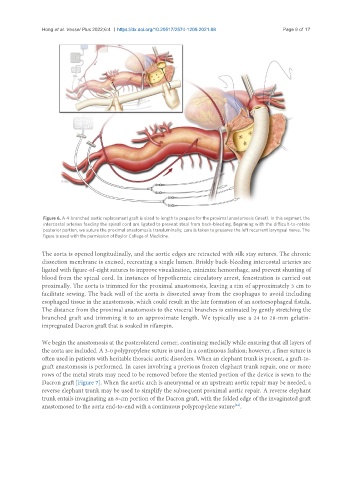
                Figure 6. A 4-branched aortic replacement graft is sized to length to prepare for the proximal anastomosis (inset). In this segment, the
                intercostal arteries feeding the spinal cord are ligated to prevent steal from back-bleeding. Beginning with the difficult-to-rotate
                posterior portion, we suture the proximal anastomosis transluminally; care is taken to preserve the left recurrent laryngeal nerve. The
                figure is used with the permission of Baylor College of Medicine.


               The aorta is opened longitudinally, and the aortic edges are retracted with silk stay sutures. The chronic
               dissection membrane is excised, recreating a single lumen. Briskly back-bleeding intercostal arteries are
               ligated with figure-of-eight sutures to improve visualization, minimize hemorrhage, and prevent shunting of
               blood from the spinal cord. In instances of hypothermic circulatory arrest, fenestration is carried out
               proximally. The aorta is trimmed for the proximal anastomosis, leaving a rim of approximately 3 cm to
               facilitate sewing. The back wall of the aorta is dissected away from the esophagus to avoid including
               esophageal tissue in the anastomosis, which could result in the late formation of an aortoesophageal fistula.
               The distance from the proximal anastomosis to the visceral branches is estimated by gently stretching the
               branched graft and trimming it to an approximate length. We typically use a 24 to 28-mm gelatin-
               impregnated Dacron graft that is soaked in rifampin.

               We begin the anastomosis at the posterolateral corner, continuing medially while ensuring that all layers of
               the aorta are included. A 3-0 polypropylene suture is used in a continuous fashion; however, a finer suture is
               often used in patients with heritable thoracic aortic disorders. When an elephant trunk is present, a graft-to-
               graft anastomosis is performed. In cases involving a previous frozen elephant trunk repair, one or more
               rows of the metal struts may need to be removed before the stented portion of the device is sewn to the
               Dacron graft [Figure 7]. When the aortic arch is aneurysmal or an upstream aortic repair may be needed, a
               reverse elephant trunk may be used to simplify the subsequent proximal aortic repair. A reverse elephant
               trunk entails invaginating an 8-cm portion of the Dacron graft, with the folded edge of the invaginated graft
                                                                                [33]
               anastomosed to the aorta end-to-end with a continuous polypropylene suture .

