


Page 10 - Read Online
P. 10
Hong et al. Vessel Plus 2022;6:4  https://dx.doi.org/10.20517/2574-1209.2021.88  Page 5 of 17


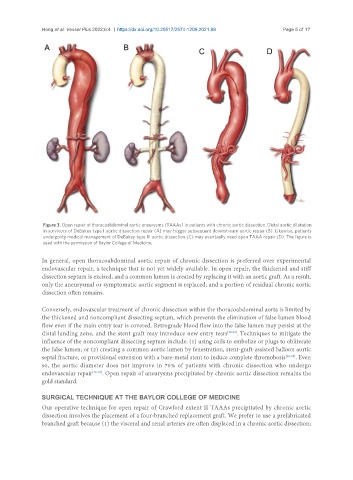
                Figure 3. Open repair of thoracoabdominal aortic aneurysms (TAAAs) in patients with chronic aortic dissection. Distal aortic dilatation
                in survivors of DeBakey type I aortic dissection repair (A) may trigger subsequent downstream aortic repair (B). Likewise, patients
                undergoing medical management of DeBakey type III aortic dissection (C) may eventually need open TAAA repair (D). The figure is
                used with the permission of Baylor College of Medicine.

               In general, open thoracoabdominal aortic repair of chronic dissection is preferred over experimental
               endovascular repair, a technique that is not yet widely available. In open repair, the thickened and stiff
               dissection septum is excised, and a common lumen is created by replacing it with an aortic graft. As a result,
               only the aneurysmal or symptomatic aortic segment is replaced, and a portion of residual chronic aortic
               dissection often remains.

               Conversely, endovascular treatment of chronic dissection within the thoracoabdominal aorta is limited by
               the thickened and noncompliant dissecting septum, which prevents the elimination of false lumen blood
               flow even if the main entry tear is covered. Retrograde blood flow into the false lumen may persist at the
               distal landing zone, and the stent graft may introduce new entry tears [20,21] . Techniques to mitigate the
               influence of the noncompliant dissecting septum include: (1) using coils to embolize or plugs to obliterate
               the false lumen; or (2) creating a common aortic lumen by fenestration, stent-graft-assisted balloon aortic
               septal fracture, or provisional extension with a bare-metal stent to induce complete thromobosis [22-25] . Even
               so, the aortic diameter does not improve in 70% of patients with chronic dissection who undergo
               endovascular repair [26-28] . Open repair of aneurysms precipitated by chronic aortic dissection remains the
               gold standard.


               SURGICAL TECHNIQUE AT THE BAYLOR COLLEGE OF MEDICINE
               Our operative technique for open repair of Crawford extent II TAAAs precipitated by chronic aortic
               dissection involves the placement of a four-branched replacement graft. We prefer to use a prefabricated
               branched graft because (1) the visceral and renal arteries are often displaced in a chronic aortic dissection;

