


Page 15 - Read Online
P. 15
Page 10 of 17                   Hong et al. Vessel Plus 2022;6:4  https://dx.doi.org/10.20517/2574-1209.2021.88


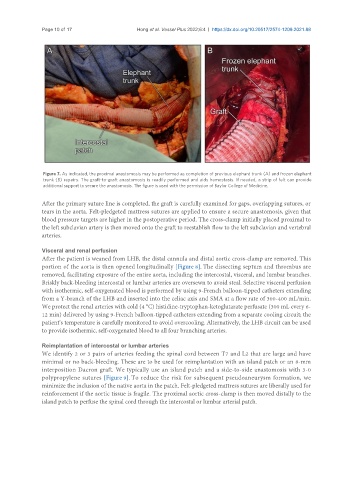
                Figure 7. As indicated, the proximal anastomosis may be performed as completion of previous elephant trunk (A) and frozen elephant
                trunk (B) repairs. The graft-to-graft anastomosis is readily performed and aids hemostasis. If needed, a strip of felt can provide
                additional support to secure the anastomosis. The figure is used with the permission of Baylor College of Medicine.

               After the primary suture line is completed, the graft is carefully examined for gaps, overlapping sutures, or
               tears in the aorta. Felt-pledgeted mattress sutures are applied to ensure a secure anastomosis, given that
               blood pressure targets are higher in the postoperative period. The cross-clamp initially placed proximal to
               the left subclavian artery is then moved onto the graft to reestablish flow to the left subclavian and vertebral
               arteries.

               Visceral and renal perfusion
               After the patient is weaned from LHB, the distal cannula and distal aortic cross-clamp are removed. This
               portion of the aorta is then opened longitudinally [Figure 8]. The dissecting septum and thrombus are
               removed, facilitating exposure of the entire aorta, including the intercostal, visceral, and lumbar branches.
               Briskly back-bleeding intercostal or lumbar arteries are oversewn to avoid steal. Selective visceral perfusion
               with isothermic, self-oxygenated blood is performed by using 9-French balloon-tipped catheters extending
               from a Y-branch of the LHB and inserted into the celiac axis and SMA at a flow rate of 300-400 mL/min.
               We protect the renal arteries with cold (4 °C) histidine-tryptophan-ketoglutarate perfusate (300 mL every 6-
               12 min) delivered by using 9-French balloon-tipped catheters extending from a separate cooling circuit; the
               patient’s temperature is carefully monitored to avoid overcooling. Alternatively, the LHB circuit can be used
               to provide isothermic, self-oxygenated blood to all four branching arteries.

               Reimplantation of intercostal or lumbar arteries
               We identify 2 or 3 pairs of arteries feeding the spinal cord between T7 and L2 that are large and have
               minimal or no back-bleeding. These are to be used for reimplantation with an island patch or an 8-mm
               interposition Dacron graft. We typically use an island patch and a side-to-side anastomosis with 3-0
               polypropylene sutures [Figure 9]. To reduce the risk for subsequent pseudoaneurysm formation, we
               minimize the inclusion of the native aorta in the patch. Felt-pledgeted mattress sutures are liberally used for
               reinforcement if the aortic tissue is fragile. The proximal aortic cross-clamp is then moved distally to the
               island patch to perfuse the spinal cord through the intercostal or lumbar arterial patch.

