


Page 13 - Read Online
P. 13
Page 8 of 17                    Hong et al. Vessel Plus 2022;6:4  https://dx.doi.org/10.20517/2574-1209.2021.88


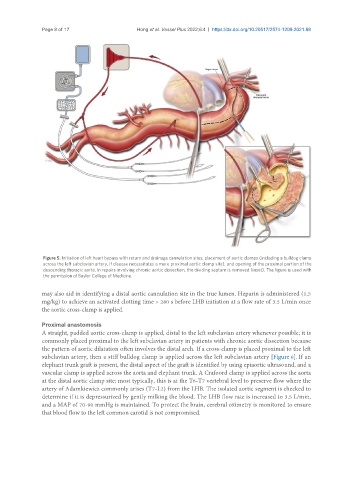
                Figure 5. Initiation of left heart bypass with return and drainage cannulation sites, placement of aortic clamps (including a bulldog clamp
                across the left subclavian artery, if disease necessitates a more proximal aortic clamp site), and opening of the proximal portion of the
                descending thoracic aorta. In repairs involving chronic aortic dissection, the dividing septum is removed (inset). The figure is used with
                the permission of Baylor College of Medicine.

               may also aid in identifying a distal aortic cannulation site in the true lumen. Heparin is administered (1.5
               mg/kg) to achieve an activated clotting time > 280 s before LHB initiation at a flow rate of 3.5 L/min once
               the aortic cross-clamp is applied.


               Proximal anastomosis
               A straight, padded aortic cross-clamp is applied, distal to the left subclavian artery whenever possible; it is
               commonly placed proximal to the left subclavian artery in patients with chronic aortic dissection because
               the pattern of aortic dilatation often involves the distal arch. If a cross-clamp is placed proximal to the left
               subclavian artery, then a stiff bulldog clamp is applied across the left subclavian artery [Figure 6]. If an
               elephant trunk graft is present, the distal aspect of the graft is identified by using epiaortic ultrasound, and a
               vascular clamp is applied across the aorta and elephant trunk. A Crafoord clamp is applied across the aorta
               at the distal aortic clamp site; most typically, this is at the T6-T7 vertebral level to preserve flow where the
               artery of Adamkiewicz commonly arises (T7-L2) from the LHB. The isolated aortic segment is checked to
               determine if it is depressurized by gently milking the blood. The LHB flow rate is increased to 3.5 L/min,
               and a MAP of 70-90 mmHg is maintained. To protect the brain, cerebral oximetry is monitored to ensure
               that blood flow to the left common carotid is not compromised.

