


Page 19 - Read Online
P. 19
Page 14 of 17                   Hong et al. Vessel Plus 2022;6:4  https://dx.doi.org/10.20517/2574-1209.2021.88


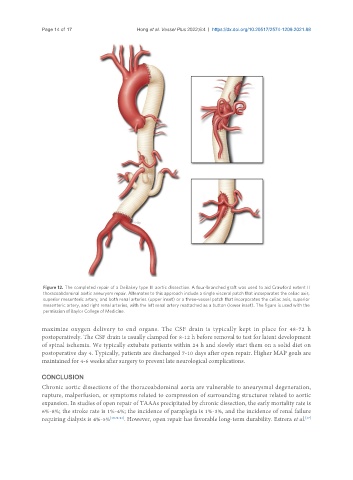
                Figure 12. The completed repair of a DeBakey type III aortic dissection. A four-branched graft was used to aid Crawford extent II
                thoracoabdominal aortic aneurysm repair. Alternates to this approach include a single visceral patch that incorporates the celiac axis,
                superior mesenteric artery, and both renal arteries (upper inset) or a three-vessel patch that incorporates the celiac axis, superior
                mesenteric artery, and right renal arteries, with the left renal artery reattached as a button (lower inset). The figure is used with the
                permission of Baylor College of Medicine.

               maximize  oxygen  delivery  to  end  organs.  The  CSF  drain  is  typically  kept  in  place  for  48-72  h
               postoperatively. The CSF drain is usually clamped for 8-12 h before removal to test for latent development
               of spinal ischemia. We typically extubate patients within 24 h and slowly start them on a solid diet on
               postoperative day 4. Typically, patients are discharged 7-10 days after open repair. Higher MAP goals are
               maintained for 4-6 weeks after surgery to prevent late neurological complications.


               CONCLUSION
               Chronic aortic dissections of the thoracoabdominal aorta are vulnerable to aneurysmal degeneration,
               rupture, malperfusion, or symptoms related to compression of surrounding structures related to aortic
               expansion. In studies of open repair of TAAAs precipitated by chronic dissection, the early mortality rate is
               6%-8%; the stroke rate is 1%-4%; the incidence of paraplegia is 1%-3%, and the incidence of renal failure
                                                                                                        [37]
               requiring dialysis is 4%-5% [19,34-41] . However, open repair has favorable long-term durability. Estrera et al.

