


Page 74 - Read Online
P. 74
Page 12 of 36                                                         Chen et al. Soft Sci. 2026, 6, 9


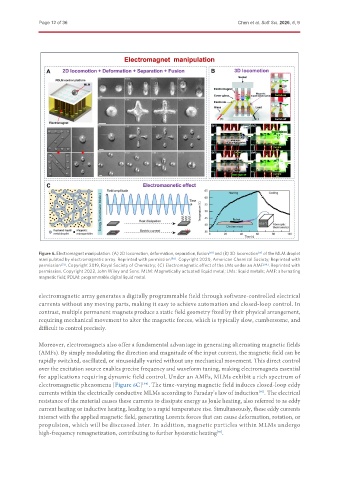
               Figure 6. Electromagnet manipulation. (A) 2D locomotion, deformation, separation, fusion [50]  and (B) 3D locomotion  of the MLM droplet
                                                                                            [51]
               manipulated by electromagnetic array. Reprinted with permission [50] . Copyright 2020, American Chemical Society; Reprinted with
               permission [51] . Copyright 2019, Royal Society of Chemistry; (C) Electromagnetic effect of the LMs under an AMF [94] . Reprinted with
               permission. Copyright 2022, John Wiley and Sons. MLM: Magnetically actuated liquid metal; LMs: liquid metals; AMF: alternating
               magnetic field; PDLM: programmable digital liquid metal.


               electromagnetic array generates a digitally programmable field through software-controlled electrical
               currents without any moving parts, making it easy to achieve automation and closed-loop control. In
               contrast, multiple permanent magnets produce a static field geometry fixed by their physical arrangement,
               requiring mechanical movement to alter the magnetic forces, which is typically slow, cumbersome, and
               difficult to control precisely.

               Moreover, electromagnets also offer a fundamental advantage in generating alternating magnetic fields
               (AMFs). By simply modulating the direction and magnitude of the input current, the magnetic field can be
               rapidly switched, oscillated, or sinusoidally varied without any mechanical movement. This direct control
               over the excitation source enables precise frequency and waveform tuning, making electromagnets essential
               for applications requiring dynamic field control. Under an AMFs, MLMs exhibit a rich spectrum of
               electromagnetic phenomena [Figure 6C] . The time-varying magnetic field induces closed-loop eddy
                                                   [94]
               currents within the electrically conductive MLMs according to Faraday’s law of induction . The electrical
                                                                                            [95]
               resistance of the material causes these currents to dissipate energy as Joule heating, also referred to as eddy
               current heating or inductive heating, leading to a rapid temperature rise. Simultaneously, these eddy currents
               interact with the applied magnetic field, generating Lorentz forces that can cause deformation, rotation, or
               propulsion, which will be discussed later. In addition, magnetic particles within MLMs undergo
               high-frequency remagnetization, contributing to further hysteretic heating .
                                                                             [96]

