


Page 78 - Read Online
P. 78
Page 16 of 36                                                         Chen et al. Soft Sci. 2026, 6, 9


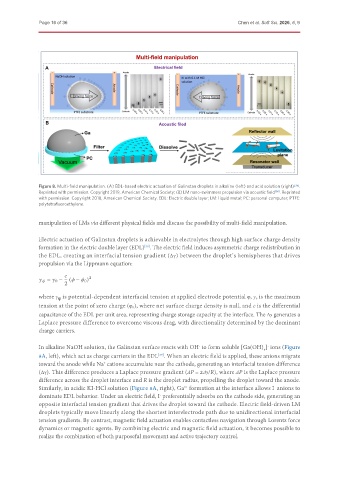
               Figure 8. Multi-field manipulation. (A) EDL-based electric actuation of Galinstan droplets in alkaline (left) and acid solution (right)  [39] .
               Reprinted with permission. Copyright 2019, American Chemical Society; (B) LM nano-swimmers propulsion via acoustic field [56] . Reprinted
               with permission. Copyright 2018, American Chemical Society. EDL: Electric double layer; LM: liquid metal; PC: personal computer; PTFE:
               polytetrafluoroethylene.


               manipulation of LMs via different physical fields and discuss the possibility of multi-field manipulation.

               Electric actuation of Galinstan droplets is achievable in electrolytes through high surface charge density
               formation in the electric double layer (EDL) . The electric field induces asymmetric charge redistribution in
                                                    [39]
               the EDL, creating an interfacial tension gradient (Δγ) between the droplet’s hemispheres that drives
               propulsion via the Lippmann equation:

                                2
                     =    0 −  (   −    0 )
                        2
               where γ  is potential-dependent interfacial tension at applied electrode potential j, γ 0 is the maximum
                     j
               tension at the point of zero charge (j 0), where net surface charge density is null, and c is the differential
               capacitance of the EDL per unit area, representing charge storage capacity at the interface. The Δγ generates a
               Laplace pressure difference to overcome viscous drag, with directionality determined by the dominant
               charge carriers.


               In alkaline NaOH solution, the Galinstan surface reacts with OH  to form soluble [Ga(OH) ]  ions (Figure
                                                                                               -
                                                                       -
                                                                                              4
               8A, left), which act as charge carriers in the EDL . When an electric field is applied, these anions migrate
                                                         [39]
               toward the anode while Na  cations accumulate near the cathode, generating an interfacial tension difference
                                     +
               (Δγ). This difference produces a Laplace pressure gradient (ΔP = 2Δγ/R), where ΔP is the Laplace pressure
               difference across the droplet interface and R is the droplet radius, propelling the droplet toward the anode.
               Similarly, in acidic KI-HCl solution (Figure 8A, right), Ga  formation at the interface allows I  anions to
                                                                  3+
                                                                                                 -
               dominate EDL behavior. Under an electric field, I  preferentially adsorbs on the cathode side, generating an
                                                         -
               opposite interfacial tension gradient that drives the droplet toward the cathode. Electric field-driven LM
               droplets typically move linearly along the shortest interelectrode path due to unidirectional interfacial
               tension gradients. By contrast, magnetic field actuation enables contactless navigation through Lorentz force
               dynamics or magnetic agents. By combining electric and magnetic field actuation, it becomes possible to
               realize the combination of both purposeful movement and active trajectory control.

