


Page 77 - Read Online
P. 77
Chen et al. Soft Sci. 2026, 6, 9                                                 Page 15 of 36


               The stabilization of LM wires can also be enabled by electrochemically mediated interfacial tension reduction
               [Figure 7B] . When a voltage of 1.5 V is applied to Galinstan in a 1M NaOH solution, surface oxidation
                         [55]
               drastically lowers interfacial tension. This allows the LM to exit the nozzle as continuous, cylindrical streams
               rather than droplets. In contrast to conventional Ohmic current, the electrical current observed in this
               system originates from electrochemically mediated redox reactions at the LM wire interface. It exhibits a
               linear dependence on the wire length, as the expanding surface area provides additional active sites for
               interfacial electron transfer. Under the combined influence of three primary forces of gravity, the Lorentz
               force, and the force arising from Lenz’s law, the manipulated streams levitate and form a distinctive spiral
               shape.


               In addition to the wire, the LM coil is another effective structure for Lorentz-force manipulation. By applying
               a current through the LM coil, it functions as an electromagnet with adjustable magnetic pole orientation
               and field strength [Figure 7C] . Under an external magnetic field, the soft robots integrated with multiple
                                        [99]
               LM coils can perform complex motions, such as running, jumping, and swimming, by independently
               controlling the current applied to each coil, as discussed later.


               Induced current
               The induced current generated within the LM under an AMF enables truly untethered magnetic
               manipulation, thereby eliminating the need for any physical wiring. This induced current arises from
               Faraday’s law of electromagnetic induction, which states that a changing magnetic flux, conceptually
               understood as the total number of magnetic field lines passing through a loop, induces an electromotive
               force (EMF) in a closed circuit. When the circuit is closed, this EMF drives an induced current. The
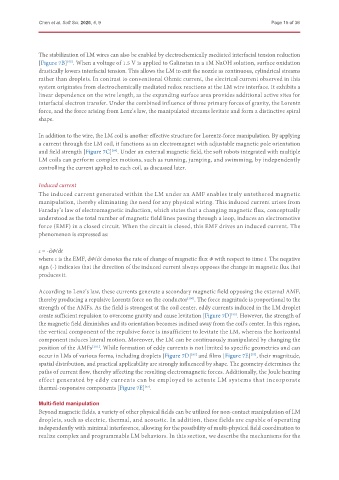
               phenomenon is expressed as:


               ε = -dΦ/dt
               where ε is the EMF, dΦ/dt denotes the rate of change of magnetic flux Φ with respect to time t. The negative
               sign (-) indicates that the direction of the induced current always opposes the change in magnetic flux that
               produces it.


               According to Lenz’s law, these currents generate a secondary magnetic field opposing the external AMF,
               thereby producing a repulsive Lorentz force on the conductor . The force magnitude is proportional to the
                                                                   [100]
               strength of the AMFs. As the field is strongest at the coil center, eddy currents induced in the LM droplet
               create sufficient repulsion to overcome gravity and cause levitation [Figure 7D] . However, the strength of
                                                                                  [95]
               the magnetic field diminishes and its orientation becomes inclined away from the coil’s center. In this region,
               the vertical component of the repulsive force is insufficient to levitate the LM, whereas the horizontal
               component induces lateral motion. Moreover, the LM can be continuously manipulated by changing the
               position of the AMFs [101] . While formation of eddy currents is not limited to specific geometries and can
               occur in LMs of various forms, including droplets [Figure 7D]  and films [Figure 7E] , their magnitude,
                                                                                         [57]
                                                                    [95]
               spatial distribution, and practical applicability are strongly influenced by shape. The geometry determines the
               paths of current flow, thereby affecting the resulting electromagnetic forces. Additionally, the Joule heating
               effect generated by eddy currents can be employed to actuate LM systems that incorporate
               thermal-responsive components [Figure 7E] .
                                                    [57]

               Multi-field manipulation
               Beyond magnetic fields, a variety of other physical fields can be utilized for non-contact manipulation of LM
               droplets, such as electric, thermal, and acoustic. In addition, these fields are capable of operating
               independently with minimal interference, allowing for the possibility of multi-physical field coordination to
               realize complex and programmable LM behaviors. In this section, we describe the mechanisms for the

