


Page 72 - Read Online
P. 72
Page 10 of 36                                                         Chen et al. Soft Sci. 2026, 6, 9


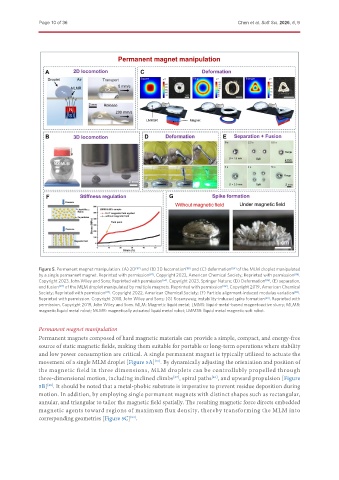
               Figure 5. Permanent magnet manipulation. (A) 2D [87]  and (B) 3D locomotion [88]  and (C) deformation [54]  of the MLM droplet manipulated
               by a single permanent magnet. Reprinted with permission [87] . Copyright 2022, American Chemical Society; Reprinted with permission [88] .
               Copyright 2023, John Wiley and Sons; Reprinted with permission  [54] . Copyright 2023, Springer Nature; (D) Deformation [89] , (E) separation,
               and fusion  [87]  of the MLM droplet manipulated by multiple magnets. Reprinted with permission [89] . Copyright 2019, American Chemical
               Society; Reprinted with permission [87] . Copyright 2022, American Chemical Society; (F) Particle alignment-induced modulus variation [90] .
               Reprinted with permission. Copyright 2018, John Wiley and Sons; (G) Rosensweig instability-induced spike formation [93] . Reprinted with
               permission. Copyright 2019, John Wiley and Sons. MLM: Magnetic liquid metal; LMMS: liquid-metal-based magnetoactive slurry; MLMR:
               magnetic liquid metal robot; MLMR: magnetically actuated liquid metal robot; LMMSR: liquid metal magnetic soft robot.

               Permanent magnet manipulation
               Permanent magnets composed of hard magnetic materials can provide a simple, compact, and energy-free
               source of static magnetic fields, making them suitable for portable or long-term operations where stability
               and low power consumption are critical. A single permanent magnet is typically utilized to actuate the
               movement of a single MLM droplet [Figure 5A] . By dynamically adjusting the orientation and position of
                                                       [87]
               the magnetic field in three dimensions, MLM droplets can be controllably propelled through
               three-dimensional motion, including inclined climbs , spiral paths , and upward propulsion [Figure
                                                                           [46]
                                                              [87]
               5B] . It should be noted that a metal-phobic substrate is imperative to prevent residue deposition during
                  [88]
               motion. In addition, by employing single permanent magnets with distinct shapes such as rectangular,
               annular, and triangular to tailor the magnetic field spatially. The resulting magnetic force directs embedded
               magnetic agents toward regions of maximum flux density, thereby transforming the MLM into
               corresponding geometries [Figure 5C] .
                                               [54]

