


Page 71 - Read Online
P. 71
Chen et al. Soft Sci. 2026, 6, 9                                                  Page 9 of 36


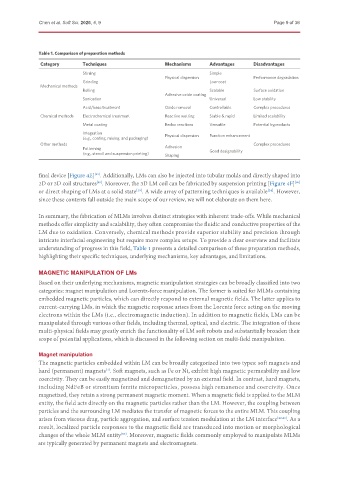
               Table 1. Comparison of preparation methods
               Category       Techniques                   Mechanisms      Advantages     Disadvantages

                              Stirring                                     Simple
                                                           Physical dispersion            Performance degradation
                              Grinding                                     Low-cost
               Mechanical methods
                              Rolling                                      Scalable       Surface oxidation
                                                           Adhesive oxide coating
                              Sonication                                   Universal      Low stability
                              Acid/base treatment          Oxide removal   Controllable   Complex procedures
               Chemical methods  Electrochemical treatment  Reactive wetting  Stable & rapid  Limited scalability
                              Metal coating                Redox reactions  Versatile     Potential byproducts
                              Integration                  Physical dispersion  Function enhancement
                              (e.g., coating, mixing, and packaging)
               Other methods                                                              Complex procedures
                              Patterning                   Adhesion        Good designability
                              (e.g., stencil and suspension printing)  Shaping


               final device [Figure 4E] . Additionally, LMs can also be injected into tubular molds and directly shaped into
                                  [83]
               2D or 3D coil structures . Moreover, the 3D LM coil can be fabricated by suspension printing [Figure 4F] [86]
                                   [85]
               or direct shaping of LMs at a solid state . A wide array of patterning techniques is available . However,
                                                 [19]
                                                                                               [24]
               since these contents fall outside the main scope of our review, we will not elaborate on them here.
               In summary, the fabrication of MLMs involves distinct strategies with inherent trade-offs. While mechanical
               methods offer simplicity and scalability, they often compromise the fluidic and conductive properties of the
               LM due to oxidation. Conversely, chemical methods provide superior stability and precision through
               intricate interfacial engineering but require more complex setups. To provide a clear overview and facilitate
               understanding of progress in this field, Table 1 presents a detailed comparison of these preparation methods,
               highlighting their specific techniques, underlying mechanisms, key advantages, and limitations.


               MAGNETIC MANIPULATION OF LMs
               Based on their underlying mechanisms, magnetic manipulation strategies can be broadly classified into two
               categories: magnet manipulation and Lorentz-force manipulation. The former is suited for MLMs containing
               embedded magnetic particles, which can directly respond to external magnetic fields. The latter applies to
               current-carrying LMs, in which the magnetic response arises from the Lorentz force acting on the moving
               electrons within the LMs (i.e., electromagnetic induction). In addition to magnetic fields, LMs can be
               manipulated through various other fields, including thermal, optical, and electric. The integration of these
               multi-physical fields may greatly enrich the functionality of LM soft robots and substantially broaden their
               scope of potential applications, which is discussed in the following section on multi-field manipulation.


               Magnet manipulation
               The magnetic particles embedded within LM can be broadly categorized into two types: soft magnets and
               hard (permanent) magnets . Soft magnets, such as Fe or Ni, exhibit high magnetic permeability and low
                                      [1]
               coercivity. They can be easily magnetized and demagnetized by an external field. In contrast, hard magnets,
               including NdFeB or strontium ferrite microparticles, possess high remanence and coercivity. Once
               magnetized, they retain a strong permanent magnetic moment. When a magnetic field is applied to the MLM
               entity, the field acts directly on the magnetic particles rather than the LM. However, the coupling between
               particles and the surrounding LM mediates the transfer of magnetic forces to the entire MLM. This coupling
               arises from viscous drag, particle aggregation, and surface tension modulation at the LM interface [42,46] . As a
               result, localized particle responses to the magnetic field are transduced into motion or morphological
               changes of the whole MLM entity . Moreover, magnetic fields commonly employed to manipulate MLMs
                                            [50]
              are typically generated by permanent magnets and electromagnets.

