


Page 66 - Read Online
P. 66
Page 4 of 36                                                          Chen et al. Soft Sci. 2026, 6, 9


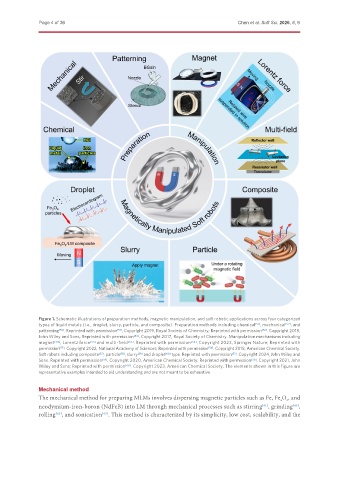
               Figure 1. Schematic illustrations of preparation methods, magnetic manipulation, and soft robotic applications across four categorized
               types of liquid metals (i.e., droplet, slurry, particle, and composite). Preparation methods including chemical [51] , mechanical [52] , and
               patterning [53] . Reprinted with permission [51] . Copyright 2019, Royal Society of Chemistry; Reprinted with permission [52] . Copyright 2018,
               John Wiley and Sons; Reprinted with permission [53] . Copyright 2017, Royal Society of Chemistry. Manipulation mechanisms including
               magnet  [54] , Lorentz force  [55]  and multi-field  [56] . Reprinted with permission [54] . Copyright 2023, Springer Nature; Reprinted with
               permission [55] . Copyright 2022, National Academy of Sciences; Reprinted with permission [56] . Copyright 2018, American Chemical Society.
               Soft robots including composite [57] , particle [58] , slurry [59]  and droplet [60]  type. Reprinted with permission [57] . Copyright 2024, John Wiley and
               Sons. Reprinted with permission [58] . Copyright 2020, American Chemical Society; Reprinted with permission [59] . Copyright 2021, John
               Wiley and Sons; Reprinted with permission [60] . Copyright 2023, American Chemical Society. The elements shown in this figure are
               representative examples intended to aid understanding and are not meant to be exhaustive.


               Mechanical method
               The mechanical method for preparing MLMs involves dispersing magnetic particles such as Fe, Fe O , and
                                                                                                      4
                                                                                                   3
               neodymium-iron-boron (NdFeB) into LM through mechanical processes such as stirring , grinding ,
                                                                                             [61]
                                                                                                        [46]
               rolling , and sonication . This method is characterized by its simplicity, low cost, scalability, and the
                     [62]
                                     [63]

