


Page 59 - Read Online
P. 59
Page 8 of 34                             Yan et al. Soft Sci. 2025, 5, 8  https://dx.doi.org/10.20517/ss.2024.66


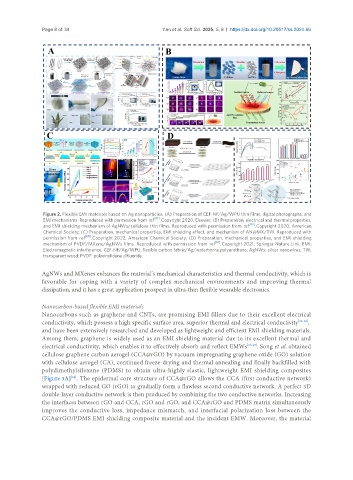
                Figure 2. Flexible EMI materials based on Ag nanoparticles. (A) Preparation of CEF-NF/Ag/WPU thin films, digital photographs, and
                EMI mechanisms. Reproduced with permission from ref [87] . Copyright 2020, Elsevier; (B) Preparation, electrical and thermal properties,
                and EMI shielding mechanism of AgNWs/cellulose thin films. Reproduced with permission from  ref [89] . Copyright 2020, American
                Chemical Society; (C) Preparation, mechanical properties, EMI shielding effect, and mechanism of AN@MX/TW. Reproduced with
                permission from  ref [90] . Copyright 2022, American Chemical Society; (D) Preparation, mechanical properties, and EMI shielding
                mechanism of PVDF/MXene/AgNWs films. Reproduced with permission from  ref [91] . Copyright 2021, Springer Nature Link. EMI:
                Electromagnetic interference; CEF-NF/Ag/WPU: flexible carbon fabric/Ag/waterborne polyurethane; AgNWs: silver nanowires; TW:
                transparent wood; PVDF: polyvinylidene difluoride.


               AgNWs and MXenes enhances the material’s mechanical characteristics and thermal conductivity, which is
               favorable for coping with a variety of complex mechanical environments and improving thermal
               dissipation, and it has a great application prospect in ultra-thin flexible wearable electronics.


               Nanocarbon-based flexible EMI materials
               Nanocarbons such as graphene and CNTs, are promising EMI fillers due to their excellent electrical
               conductivity, which possess a high specific surface area, superior thermal and electrical conductivity [92-94] ,
               and have been extensively researched and developed as lightweight and efficient EMI shielding materials.
               Among them, graphene is widely used as an EMI shielding material due to its excellent thermal and
               electrical conductivity, which enables it to effectively absorb and reflect EMWs [95-97] . Song et al. obtained
               cellulose graphene carbon aerogel (CCA@rGO) by vacuum impregnating graphene oxide (GO) solution
               with cellulose aerogel (CA), continued freeze-drying and thermal annealing and finally backfilled with
               polydimethylsiloxane (PDMS) to obtain ultra-highly elastic, lightweight EMI shielding composites
               [Figure 3A] . The epidermal core structure of CCA@rGO allows the CCA (first conductive network)
                         [98]
               wrapped with reduced GO (rGO) to gradually form a flawless second conductive network. A perfect 3D
               double-layer conductive network is then produced by combining the two conductive networks. Increasing
               the interfaces between rGO and CCA, rGO and rGO, and CCA@rGO and PDMS matrix simultaneously
               improves the conductive loss, impedance mismatch, and interfacial polarization loss between the
               CCA@rGO/PDMS EMI shielding composite material and the incident EMW. Moreover, the material

