


Page 58 - Read Online
P. 58
Yan et al. Soft Sci. 2025, 5, 8  https://dx.doi.org/10.20517/ss.2024.66          Page 7 of 34


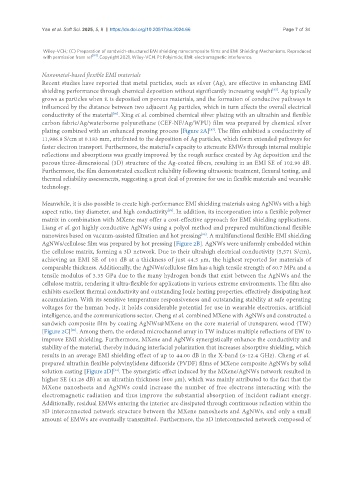
                Wiley-VCH; (C) Preparation of sandwich-structured EMI shielding nanocomposite films and EMI Shielding Mechanisms. Reproduced
                with permission from ref [84] . Copyright 2021, Wiley-VCH. PI: Polyimide; EMI: electromagnetic interference.

               Nanometal-based flexible EMI materials
               Recent studies have reported that metal particles, such as silver (Ag), are effective in enhancing EMI
                                                                                             [85]
               shielding performance through chemical deposition without significantly increasing weight . Ag typically
               grows as particles when it is deposited on porous materials, and the formation of conductive pathways is
               influenced by the distance between two adjacent Ag particles, which in turn affects the overall electrical
                                       [86]
               conductivity of the material . Xing et al. combined chemical silver plating with an ultrathin and flexible
               carbon fabric/Ag/waterborne polyurethane (CEF-NF/Ag/WPU) film was prepared by chemical silver
               plating combined with an enhanced pressing process [Figure 2A] . The film exhibited a conductivity of
                                                                        [87]
               11,986.8 S/cm at 0.183 mm, attributed to the deposition of Ag particles, which form extended pathways for
               faster electron transport. Furthermore, the material’s capacity to attenuate EMWs through internal multiple
               reflections and absorptions was greatly improved by the rough surface created by Ag deposition and the
               porous three-dimensional (3D) structure of the Ag-coated fibers, resulting in an EMI SE of 102.90 dB.
               Furthermore, the film demonstrated excellent reliability following ultrasonic treatment, flexural testing, and
               thermal reliability assessments, suggesting a great deal of promise for use in flexible materials and wearable
               technology.


               Meanwhile, it is also possible to create high-performance EMI shielding materials using AgNWs with a high
                                                          [88]
               aspect ratio, tiny diameter, and high conductivity . In addition, its incorporation into a flexible polymer
               matrix in combination with MXene may offer a cost-effective approach for EMI shielding applications.
               Liang et al. got highly conductive AgNWs using a polyol method and prepared multifunctional flexible
                                                                     [89]
               nanowires based on vacuum-assisted filtration and hot pressing . A multifunctional flexible EMI shielding
               AgNWs/cellulose film was prepared by hot pressing [Figure 2B]. AgNWs were uniformly embedded within
               the cellulose matrix, forming a 3D network. Due to their ultrahigh electrical conductivity (5,571 S/cm),
               achieving an EMI SE of 101 dB at a thickness of just 44.5 μm, the highest reported for materials of
               comparable thickness. Additionally, the AgNWs/cellulose film has a high tensile strength of 60.7 MPa and a
               tensile modulus of 3.35 GPa due to the many hydrogen bonds that exist between the AgNWs and the
               cellulose matrix, rendering it ultra-flexible for applications in various extreme environments. The film also
               exhibits excellent thermal conductivity and outstanding Joule heating properties, effectively dissipating heat
               accumulation. With its sensitive temperature responsiveness and outstanding stability at safe operating
               voltages for the human body, it holds considerable potential for use in wearable electronics, artificial
               intelligence, and the communications sector. Cheng et al. combined MXene with AgNWs and constructed a
               sandwich composite film by coating AgNWs@MXene on the core material of transparent wood (TW)
               [Figure 2C] . Among them, the ordered microchannel array in TW induces multiple reflections of EW to
                         [90]
               improve EMI shielding. Furthermore, MXene and AgNWs synergistically enhance the conductivity and
               stability of the material, thereby inducing interfacial polarization that increases absorptive shielding, which
               results in an average EMI shielding effect of up to 44.00 dB in the X-band (8-12.4 GHz). Cheng et al.
               prepared ultrathin flexible polyvinylidene difluoride (PVDF) films of MXene composite AgNWs by solid
               solution casting [Figure 2D] . The synergistic effect induced by the MXene/AgNWs network resulted in
                                       [91]
               higher SE (41.26 dB) at an ultrathin thickness (600 μm), which was mainly attributed to the fact that the
               MXene nanosheets and AgNWs could increase the number of free electrons interacting with the
               electromagnetic radiation and thus improve the substantial absorption of incident radiant energy.
               Additionally, residual EMWs entering the interior are dissipated through continuous reflection within the
               3D interconnected network structure between the MXene nanosheets and AgNWs, and only a small
               amount of EMWs are eventually transmitted. Furthermore, the 3D interconnected network composed of

