


Page 55 - Read Online
P. 55
Page 4 of 34                             Yan et al. Soft Sci. 2025, 5, 8  https://dx.doi.org/10.20517/ss.2024.66

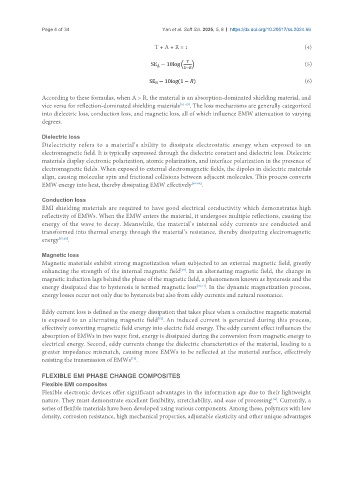
                                                     T + A + R = 1                                                                               (4)


                                                                                                        (5)

                                                                                                        (6)


               According to these formulas, when A > R, the material is an absorption-dominated shielding material, and
               vice versa for reflection-dominated shielding materials [61-63] . The loss mechanisms are generally categorized
               into dielectric loss, conduction loss, and magnetic loss, all of which influence EMW attenuation to varying
               degrees.

               Dielectric loss
               Dielectricity  refers  to  a  material’s  ability  to  dissipate  electrostatic  energy  when  exposed  to  an
               electromagnetic field. It is typically expressed through the dielectric constant and dielectric loss. Dielectric
               materials display electronic polarization, atomic polarization, and interface polarization in the presence of
               electromagnetic fields. When exposed to external electromagnetic fields, the dipoles in dielectric materials
               align, causing molecular spin and frictional collisions between adjacent molecules. This process converts
               EMW energy into heat, thereby dissipating EMW effectively [64-66] .


               Conduction loss
               EMI shielding materials are required to have good electrical conductivity which demonstrates high
               reflectivity of EMWs. When the EMW enters the material, it undergoes multiple reflections, causing the
               energy of the wave to decay. Meanwhile, the material’s internal eddy currents are conducted and
               transformed into thermal energy through the material’s resistance, thereby dissipating electromagnetic
               energy [67,68] .

               Magnetic loss
               Magnetic materials exhibit strong magnetization when subjected to an external magnetic field, greatly
                                                              [69]
               enhancing the strength of the internal magnetic field . In an alternating magnetic field, the change in
               magnetic induction lags behind the phase of the magnetic field, a phenomenon known as hysteresis and the
               energy dissipated due to hysteresis is termed magnetic loss [70,71] . In the dynamic magnetization process,
               energy losses occur not only due to hysteresis but also from eddy currents and natural resonance.


               Eddy current loss is defined as the energy dissipation that takes place when a conductive magnetic material
                                                      [72]
               is exposed to an alternating magnetic field . An induced current is generated during this process,
               effectively converting magnetic field energy into electric field energy. The eddy current effect influences the
               absorption of EMWs in two ways: first, energy is dissipated during the conversion from magnetic energy to
               electrical energy. Second, eddy currents change the dielectric characteristics of the material, leading to a
               greater impedance mismatch, causing more EMWs to be reflected at the material surface, effectively
               resisting the transmission of EMWs .
                                             [73]

               FLEXIBLE EMI PHASE CHANGE COMPOSITES
               Flexible EMI composites
               Flexible electronic devices offer significant advantages in the information age due to their lightweight
               nature. They must demonstrate excellent flexibility, stretchability, and ease of processing . Currently, a
                                                                                             [74]
               series of flexible materials have been developed using various components. Among these, polymers with low
               density, corrosion resistance, high mechanical properties, adjustable elasticity and other unique advantages

