


Page 63 - Read Online
P. 63
Page 12 of 34                            Yan et al. Soft Sci. 2025, 5, 8  https://dx.doi.org/10.20517/ss.2024.66

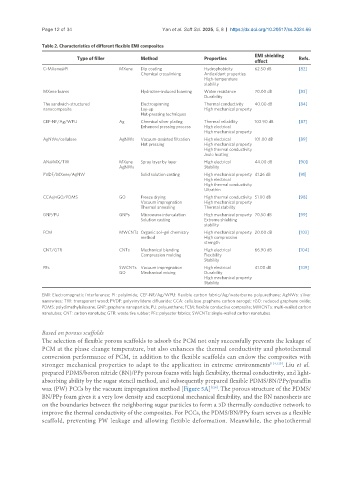
               Table 2. Characteristics of different flexible EMI composites
                                                                                       EMI shielding
                           Type of filler       Method                Properties                      Refs.
                                                                                       effect
                C-MXene@PI               MXene  Dip coating           Hydrophobicity   62.50 dB       [82]
                                                Chemical crosslinking  Antioxidant properties
                                                                      High-temperature
                                                                      stability
                MXene foams                     Hydrazine-induced foaming  Water resistance   70.00 dB  [83]
                                                                      Durability
                The sandwich-structured         Electrospinning       Thermal conductivity   40.00 dB  [84]
                nanocomposite                   Lay-up                High mechanical property
                                                Hot-pressing techniques
                CEF-NF/Ag/WPU            Ag     Chemical silver plating   Thermal reliability   102.90 dB  [87]
                                                Enhanced pressing process  High electrical
                                                                      High mechanical property
                AgNWs/cellulose          AgNWs  Vacuum-assisted filtration   High electrical   101.00 dB  [89]
                                                Hot pressing          High mechanical property
                                                                      High thermal conductivity
                                                                      Joule heating
                AN@MX/TW                 MXene   Spray layer by layer  High electrical   44.00 dB     [90]
                                         AgNWs                        Stability
                PVDF/MXene/AgNW                 Solid solution casting  High mechanical property  41.26 dB  [91]
                                                                      High electrical
                                                                      High thermal conductivity
                                                                      Ultrathin
                CCA@rGO/PDMS             GO     Freeze drying         High thermal conductivity  51.00 dB  [98]
                                                Vacuum impregnation   High mechanical property
                                                Thermal annealing     Thermal stability
                GNP/PU                   GNPs   Microwave intercalation   High mechanical property  70.50 dB  [99]
                                                Solution casting      Extreme shielding
                                                                      stability
                FCM                      MWCNTs Organic sol–gel chemistry   High mechanical property  20.00 dB  [103]
                                                method                High compressive
                                                                      strength
                CNT/GTR                  CNTs   Mechanical blending   High electrical   66.90 dB      [104]
                                                Compression molding   Flexibility
                                                                      Stability
                PFs                      SWCNTs  Vacuum impregnation   High electrical   41.00 dB     [109]
                                         GO     Mechanical mixing     Durability
                                                                      High mechanical property
                                                                      Stability

               EMI: Electromagnetic interference; PI: polyimide; CEF-NF/Ag/WPU: flexible carbon fabric/Ag/waterborne polyurethane; AgNWs: silver
               nanowires; TW: transparent wood; PVDF: polyvinylidene difluoride; CCA: cellulose graphene carbon aerogel; rGO: reduced graphene oxide;
               PDMS: polydimethylsiloxane; GNP: graphene nanoparticle; PU: polyurethane; FCM: flexible conductive composite; MWCNTs: multi-walled carbon
               nanotubes; CNT: carbon nanotube; GTR: waste tire rubber; PFs: polyester fabrics; SWCNTs: single-walled carbon nanotubes.

               Based on porous scaffolds
               The selection of flexible porous scaffolds to adsorb the PCM not only successfully prevents the leakage of
               PCM at the phase change temperature, but also enhances the thermal conductivity and photothermal
               conversion performance of PCM, in addition to the flexible scaffolds can endow the composites with
               stronger mechanical properties to adapt to the application in extreme environments [124,125] . Liu et al.
               prepared PDMS/boron nitride (BN)/PPy porous foams with high flexibility, thermal conductivity, and light-
               absorbing ability by the sugar stencil method, and subsequently prepared flexible PDMS/BN/PPy/paraffin
                                                                        [126]
               wax (PW) PCCs by the vacuum impregnation method [Figure 5A] . The porous structure of the PDMS/
               BN/PPy foam gives it a very low density and exceptional mechanical flexibility, and the BN nanosheets are
               on the boundaries between the neighboring sugar particles to form a 3D thermally conductive network to
               improve the thermal conductivity of the composites. For PCCs, the PDMS/BN/PPy foam serves as a flexible
               scaffold, preventing PW leakage and allowing flexible deformation. Meanwhile, the photothermal

