


Page 64 - Read Online
P. 64
Yan et al. Soft Sci. 2025, 5, 8  https://dx.doi.org/10.20517/ss.2024.66         Page 13 of 34


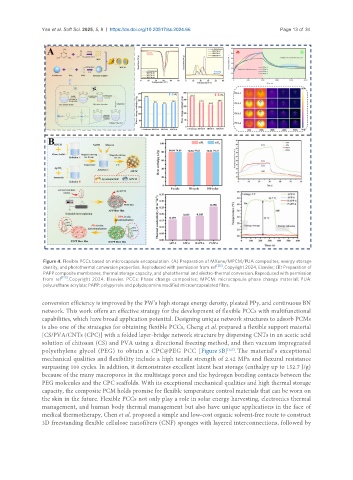
                Figure 4. Flexible PCCs based on microcapsule encapsulation. (A) Preparation of MXene/MPCM/PUA composites, energy storage
                                                                          [122]
                density, and photothermal conversion properties. Reproduced with permission from ref  . Copyright 2024, Elsevier; (B) Preparation of
                PAPP composite membranes, thermal storage capacity, and photothermal and electro-thermal conversion. Reproduced with permission
                      [123]
                from  ref  . Copyright  2024,  Elsevier.  PCCs:  Phase  change  composites;  MPCM:  microcapsule  phase  change  material;  PUA:
                polyurethane acrylate; PAPP: polypyrrole and polydopamine modified microencapsulated films.
               conversion efficiency is improved by the PW’s high storage energy density, pleated PPy, and continuous BN
               network. This work offers an effective strategy for the development of flexible PCCs with multifunctional
               capabilities, which have broad application potential. Designing unique network structures to adsorb PCMs
               is also one of the strategies for obtaining flexible PCCs, Cheng et al. prepared a flexible support material
               [CS/PVA/CNTs (CPC)] with a folded layer-bridge network structure by dispersing CNTs in an acetic acid
               solution of chitosan (CS) and PVA using a directional freezing method, and then vacuum impregnated
               polyethylene glycol (PEG) to obtain a CPC@PEG PCC [Figure 5B] . The material’s exceptional
                                                                              [127]
               mechanical qualities and flexibility include a high tensile strength of 2.42 MPa and flexural resistance
               surpassing 100 cycles. In addition, it demonstrates excellent latent heat storage (enthalpy up to 152.7 J/g)
               because of the many macropores in the multistage pores and the hydrogen bonding contacts between the
               PEG molecules and the CPC scaffolds. With its exceptional mechanical qualities and high thermal storage
               capacity, the composite PCM holds promise for flexible temperature control materials that can be worn on
               the skin in the future. Flexible PCCs not only play a role in solar energy harvesting, electronics thermal
               management, and human body thermal management but also have unique applications in the face of
               medical thermotherapy, Chen et al. proposed a simple and low-cost organic solvent-free route to construct
               3D freestanding flexible cellulose nanofibers (CNF) sponges with layered interconnections, followed by

