


Page 69 - Read Online
P. 69
Page 18 of 34                            Yan et al. Soft Sci. 2025, 5, 8  https://dx.doi.org/10.20517/ss.2024.66

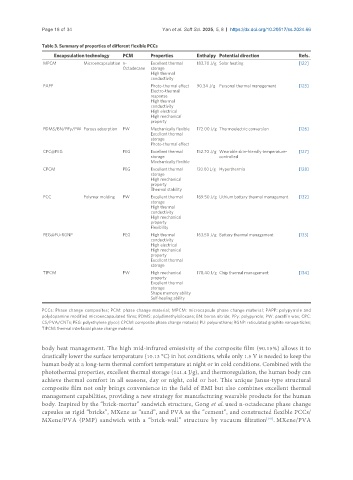
               Table 3. Summary of properties of different flexible PCCs
                   Encapsulation technology  PCM    Properties     Enthalpy Potential direction       Refs.
                MPCM         Microencapsulation n-  Excellent thermal   183.70 J/g Solar heating      [122]
                                          Octadecane  storage
                                                    High thermal
                                                    conductivity
                PAPP                                Photo-thermal effect   90.34 J/g Personal thermal management  [123]
                                                    Electro-thermal
                                                    response
                                                    High thermal
                                                    conductivity
                                                    High electrical
                                                    High mechanical
                                                    property
                PDMS/BN/PPy/PW Porous adsorption  PW  Mechanically flexible   172.00 J/g Thermoelectric conversion  [126]
                                                    Excellent thermal
                                                    storage
                                                    Photo-thermal effect
                CPC@PEG                   PEG       Excellent thermal   152.70 J/g Wearable skin-friendly temperature-  [127]
                                                    storage                controlled
                                                    Mechanically flexible
                CPCM                      PEG       Excellent thermal   120.00 J/g Hyperthermia       [128]
                                                    storage
                                                    High mechanical
                                                    property
                                                    Thermal stability
                PCC          Polymer molding  PW    Excellent thermal   169.50 J/g Lithium battery thermal management  [132]
                                                    storage
                                                    High thermal
                                                    conductivity
                                                    High mechanical
                                                    property
                                                    Flexibility
                PEG@PU-RGNP               PEG       High thermal   163.50 J/g Battery thermal management  [133]
                                                    conductivity
                                                    High electrical
                                                    High mechanical
                                                    property
                                                    Excellent thermal
                                                    storage
                TIPCM                     PW        High mechanical   178.40 J/g Chip thermal management  [134]
                                                    property
                                                    Excellent thermal
                                                    storage
                                                    Shape memory ability
                                                    Self-healing ability

               PCCs: Phase change composites; PCM: phase change material; MPCM: microcapsule phase change material; PAPP: polypyrrole and
               polydopamine modified microencapsulated films; PDMS: polydimethylsiloxane; BN: boron nitride; PPy: polypyrrole; PW: paraffin wax; CPC:
               CS/PVA/CNTs; PEG: polyethylene glycol; CPCM: composite phase change material; PU: polyurethane; RGNP: reticulated graphite nanoparticles;
               TIPCM: thermal interfacial phase change material.

               body heat management. The high mid-infrared emissivity of the composite film (90.15%) allows it to
               drastically lower the surface temperature (10.13 °C) in hot conditions, while only 1.5 V is needed to keep the
               human body at a long-term thermal comfort temperature at night or in cold conditions. Combined with the
               photothermal properties, excellent thermal storage (141.4 J/g), and thermoregulation, the human body can
               achieve thermal comfort in all seasons, day or night, cold or hot. This unique Janus-type structural
               composite film not only brings convenience in the field of EMI but also combines excellent thermal
               management capabilities, providing a new strategy for manufacturing wearable products for the human
               body. Inspired by the “brick-mortar” sandwich structure, Gong et al. used n-octadecane phase change
               capsules as rigid “bricks”, MXene as “sand”, and PVA as the “cement”, and constructed flexible PCCs/
               MXene/PVA (PMP) sandwich with a “brick-wall” structure by vacuum filtration . MXene/PVA
                                                                                           [141]

