


Page 70 - Read Online
P. 70
Yan et al. Soft Sci. 2025, 5, 8  https://dx.doi.org/10.20517/ss.2024.66         Page 19 of 34


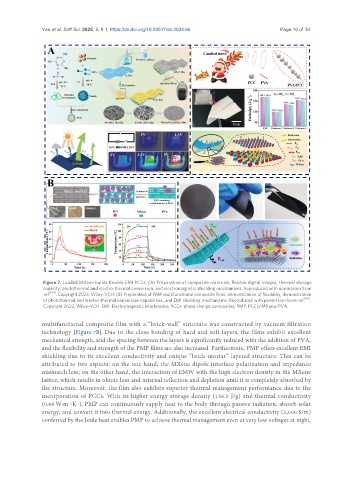
                Figure 7. Loaded MXene builds flexible EMI PCCs. (A) Preparation of composite materials, flexible digital images, thermal storage
                capacity, photothermal and electro-thermal conversion, and electromagnetic shielding mechanisms. Reproduced with permission from
                ref [140] . Copyright 2023, Wiley-VCH; (B) Preparation of PMP multifunctional composite films, demonstration of flexibility, demonstration
                of photothermal and electro-thermal conversion capabilities, and EMI shielding mechanisms. Reproduced with permission from ref [141] .
                Copyright 2022, Wiley-VCH. EMI: Electromagnetic interference; PCCs: phase change composites; PMP: PCCs/MXene/PVA.

               multifunctional composite film with a “brick-wall” structure was constructed by vacuum filtration
               technology [Figure 7B]. Due to the close bonding of hard and soft layers, the films exhibit excellent
               mechanical strength, and the spacing between the layers is significantly reduced with the addition of PVA,
               and the flexibility and strength of the PMP films are also increased. Furthermore, PMP offers excellent EMI
               shielding due to its excellent conductivity and unique “brick-mortar” layered structure. This can be
               attributed to two aspects: on the one hand, the MXene dipole interface polarization and impedance
               mismatch loss; on the other hand, the interaction of EMW with the high electron density in the MXene
               lattice, which results in ohmic loss and internal reflection and depletion until it is completely absorbed by
               the structure. Moreover, the film also exhibits superior thermal management performance due to the
               incorporation of PCCs. With its higher energy storage density (136.5 J/g) and thermal conductivity
               (0.69 W·m ·K ), PMP can continuously supply heat to the body through passive radiation, absorb solar
                        -1
                           -1
               energy, and convert it into thermal energy. Additionally, the excellent electrical conductivity (5,000 S/m)
               conferred by the Joule heat enables PMP to achieve thermal management even at very low voltages at night,

