


Page 137 - Read Online
P. 137
Xu et al. Soft Sci. 2025, 5, 43  https://dx.doi.org/10.20517/ss.2025.63         Page 11 of 16


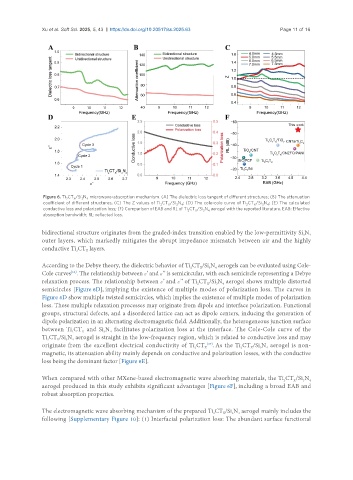
                Figure 6. Ti CT /Si N  microwave-absorption mechanism. (A) The dielectric loss tangent of different structures; (B) The attenuation
                              4
                       2
                          X
                             3
                coefficient of different structures, (C) The Z values of Ti CT /Si N ; (D) The cole-cole curve of Ti CT /Si N ; (E) The calculated
                                                       2
                                                            3
                                                              4
                                                          X
                                                                                         3
                                                                                           4
                                                                                    2
                                                                                       X
                conductive loss and polarization loss; (F) Comparison of EAB and RL of Ti CT /Si N  aerogel with the reported literature. EAB: Effective
                                                                     3
                                                                       4
                                                                2
                                                                   X
                absorption bandwidth; RL: reflected loss.
               bidirectional structure originates from the graded-index transition enabled by the low-permittivity Si N
                                                                                                         4
                                                                                                       3
               outer layers, which markedly mitigates the abrupt impedance mismatch between air and the highly
               conductive Ti CT  layers.
                              X
                           2
               According to the Debye theory, the dielectric behavior of Ti CT /Si N  aerogels can be evaluated using Cole-
                                                                    X
                                                                       3
                                                                          4
                                                                 2
                         [66]
               Cole curves . The relationship between ε’ and ε’’ is semicircular, with each semicircle representing a Debye
               relaxation process. The relationship between ε’ and ε’’ of Ti CT /Si N  aerogel shows multiple distorted
                                                                   2
                                                                       X
                                                                            4
                                                                          3
               semicircles [Figure 6D], implying the existence of multiple modes of polarization loss. The curves in
               Figure 6D show multiple twisted semicircles, which implies the existence of multiple modes of polarization
               loss. These multiple relaxation processes may originate from dipole and interface polarization. Functional
               groups, structural defects, and a disordered lattice can act as dipole centers, inducing the generation of
               dipole polarization in an alternating electromagnetic field. Additionally, the heterogeneous junction surface
               between Ti CT  and Si N  facilitates polarization loss at the interface. The Cole-Cole curve of the
                                      4
                                    3
                         2
                             X
               Ti CT /Si N  aerogel is straight in the low-frequency region, which is related to conductive loss and may
                         4
                       3
                 2
                    X
               originate from the excellent electrical conductivity of Ti CT X [67] . As the Ti CT /Si N  aerogel is non-
                                                                                         3
                                                                                  2
                                                                                     X
                                                                                           4
                                                                   2
               magnetic, its attenuation ability mainly depends on conductive and polarization losses, with the conductive
               loss being the dominant factor [Figure 6E].
               When compared with other MXene-based electromagnetic wave absorbing materials, the Ti CT /Si N
                                                                                                 2
                                                                                                         4
                                                                                                       3
                                                                                                    X
               aerogel produced in this study exhibits significant advantages [Figure 6F], including a broad EAB and
               robust absorption properties.
               The electromagnetic wave absorbing mechanism of the prepared Ti CT /Si N  aerogel mainly includes the
                                                                            X
                                                                         2
                                                                               3
                                                                                 4
               following [Supplementary Figure 10]: (1) Interfacial polarization loss: The abundant surface functional

