


Page 65 - Read Online
P. 65
Page 8 of 21                              Liu et al. Soft Sci 2024;4:44  https://dx.doi.org/10.20517/ss.2024.59


                                                                     -
                                                                       -
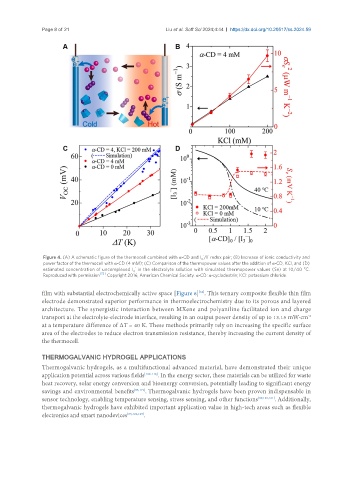
                Figure 4. (A) A schematic figure of the thermocell combined with α-CD and I /I  redox pair; (B) Increase of ionic conductivity and
                                                                     3
                power factor of the thermocell with α-CD (4 mM); (C) Comparison of the thermopower values after the addition of α-CD, KCl, and (D)
                                                                                                       o
                                              -
                estimated concentration of uncomplexed I  in the electrolyte solution with simulated thermopower values (Se) at 10/40  C.
                                              3
                Reproduced with permission [72] . Copyright 2016, American Chemical Society. α-CD: α-cyclodextrin; KCl: potassium chloride.
               film with substantial electrochemically active space [Figure 6] . This ternary composite flexible thin film
                                                                    [64]
               electrode demonstrated superior performance in thermoelectrochemistry due to its porous and layered
               architecture. The synergistic interaction between MXene and polyaniline facilitated ion and charge
               transport at the electrolyte-electrode interface, resulting in an output power density of up to 13.15 mW·cm
                                                                                                         -2
               at a temperature difference of ∆T = 40 K. These methods primarily rely on increasing the specific surface
               area of the electrodes to reduce electron transmission resistance, thereby increasing the current density of
               the thermocell.

               THERMOGALVANIC HYDROGEL APPLICATIONS
               Thermogalvanic hydrogels, as a multifunctional advanced material, have demonstrated their unique
               application potential across various fields [109-118] . In the energy sector, these materials can be utilized for waste
               heat recovery, solar energy conversion and bioenergy conversion, potentially leading to significant energy
               savings and environmental benefits [65,119] . Thermogalvanic hydrogels have been proven indispensable in
               sensor technology, enabling temperature sensing, stress sensing, and other functions [89,120,121] . Additionally,
               thermogalvanic hydrogels have exhibited important application value in high-tech areas such as flexible
               electronics and smart nanodevices [63,122,123] .

